

Baba Sheba, Professor of Digital Education and Transformation led the university-wide event.
Last month, staff and students from across the City St George’s, University of London community convened for its inaugural AI Research Day, organised by Baba Sheba, Professor of Digital Education and Transformation at the University.
They heard from some of its many academics who lead research in the rapidly evolving field of artificial intelligence (AI), with the aim of exploring the opportunities and challenges posed by AI’s ever increasing presence in society, and what University’s responses to them could be.
Welcome addresses
In his address, Professor Richard Ashcroft, Executive Dean of The City Law School and co-chair of the University’s AI Accelerator and Change Committee’s research stream, described artificial intelligence as a challenge that extends far beyond science and technology, saying:

He argued that society is not separate from technology, but rather "written into" it, and while universities are places that do the fundamental research into AI, and explore how it may be applied in the real world, they are also uniquely placed to examine how values, ethics and human agency shape its future.
In her address, Professor Susannah Quinsee, Vice-President (Digital and Student Experience), emphasised how universities must do more than simply respond to technological change. As sectors across society are transformed, she argued that universities have a responsibility to help shape that change.
Highlighting City St George's ambition to become one of the UK's most digitally capable universities, she stressed the importance of curiosity, collaboration and partnership with students in preparing for a rapidly evolving future.

Keynote lecture
The event's keynote lecture was delivered by Dr Christina Malamateniou, Reader/Associate Professor in Technology Enabled Care in Radiography.
Drawing upon examples from radiography and digital health, she demonstrated how AI is already improving diagnosis and patient care. She also cautioned that successful adoption depends not only on technology, but also on leadership, governance and maintaining a human-centred approach to innovation.

Lightning talks
The keynote was followed by a series of 10 five minute ‘lightning talks’, which focused on AI research projects, methods, collaboration opportunities and support needs.
Speakers included Dr Jafar Sabbah, Professor Stian Reimers, Dr Hannah Thompson, Dr Rachel Holland, Monica Visani Scozzi, Professor Enrico Bonadio, Divya Srivastava, Dr Xiaogang Che, Esme Palaganas, Dr Ilias Kapsis, Dr Luis da Vinha, Daniel Sikar and Dr Dave Muir.
Professor Reimers from the School of Health & Medical Science delivered his talk on ‘building AI chatbots to support speech recovery in aphasia’.
Monica Visani Scozzi, a PhD student in Human Computer Interaction in Generative AIs from the School of Science & Technology, examined verification challenges with Large Language Models (LLMs).
Dr Ilias Kapsis of The City Law School presented the School’s AI research themes, introducing the new Research Centre for Emerging Technologies and Law (CETL) which is currently under development.

The final talk was co-delivered by PhD candidate, Daniel Sikar and Dr Dave Muir of the School of Science & Technology. The pair discussed how hackathons can accelerate the adoption of agentic AI among researchers, students and professionals.
Spotlight talks
More in-depth ‘spotlight’ talks followed from Dr Tillman Weyde, Director of the AI Research Centre, who shared what the Centre enables, its current portfolio, how to engage with it, and from Dr Sara Jones, Director of the Institute for Creativity and AI, who spoke of the institutes’ translational, industry-facing AI capability and partnerships, what it is working and what is next on the horizon.
The Elephant in the Data Centre
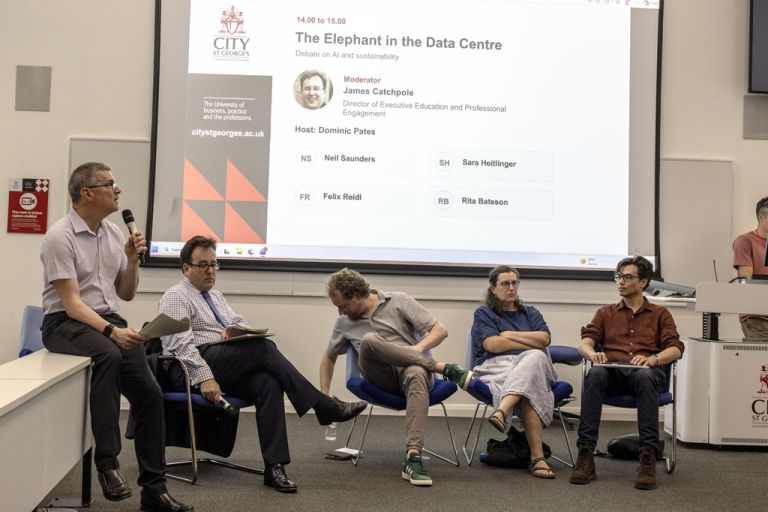
After lunch, the day resumed with a panel debate, hosted in-person and online, entitled, ‘The Elephant in the Data Centre’, organised by Dom Pates, Senior Educational Technologist, Learning Enhancement and Development, and moderated by James Catchpole, Director of Executive Education and Professional Engagement at The City Law School.
Across the debate, the audience voted on whether they agreed or disagreed with the motion:
"This house believes that AI deployment should be paused due to the environmental risks it currently poses."
Panellists included, Dr Sara Heitlinger and Dr Neil Saunders from the School of Science & Technology; Dr Felix Reidl, Birkbeck, University of London, and Rita Bateson from Eblana Learning, in Ireland.
Panel debate - gallery


Supporting research students use of AI
A final panel and Q&A session on the support doctoral students and researchers will need in using or engaging with AI was chaired by Professor Esther Mondragón and explored practical support, guardrails, routes to help, and commonly expressed needs.
The last Spotlight talk of the day came from Dr Divya Srivastava, on the AI digital Health Lab at the Centre for Health and Care Innovation Research.
Concluding remarks
To conclude the day, remarks were delivered by Professor Sheba.
By Ellie Norman, Press Communications Assistant, and Neo Valverde Sebunya, Press Communications Assistant
Related schools, departments and centres
Other stories you might like
-
City St George’s launches new AI degrees led by world-class experts in the heart of London
City St George's opens applications for its new undergraduate degree courses in AI, where students get hands-on from the outset, designing and building real AI systems from their first year of study.
-
GenAI Day: Exploring possibilities, addressing realities
On 5 June, 100 attendees gathered at our Tooting campus for a vibrant day of exploration, discussion and practical insight into Generative AI (GenAI).
-
City St George’s hosts GenAI and Assessment Day
The University hosts a day of talks and discussions to help it keep assessment authentic, fair and future ready in the age of generative AI.

