

The US Experts group at City St George’s, University of London host a panel reflecting on the US midterms and give predictions for what it lies ahead.
By Eve Lacroix (Senior Communications Officer), Published
The US midterm elections saw the Democrat party win the US Senate and the House of Representatives.
This means the opposing party have effectively taken control of the Congress over the ruling Republican party for the two remaining years of President Trump’s presidency.
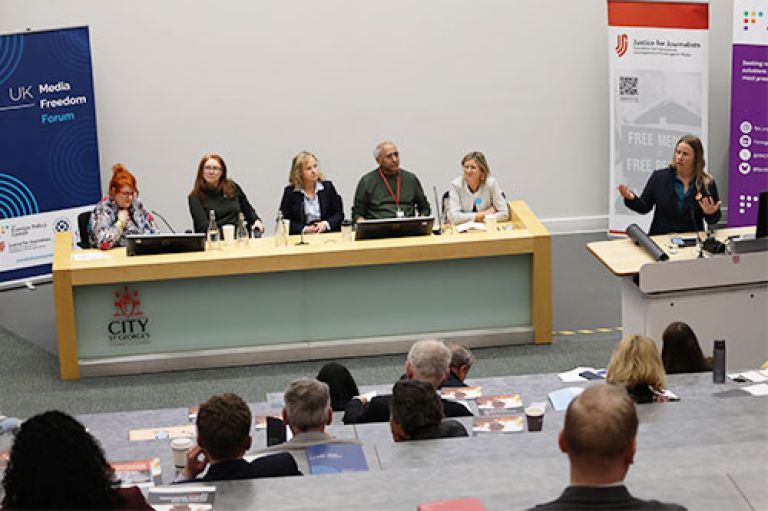
Experts from the US Experts Group and the Centre for Journalism & Democracy (CJD) at City St George's, University of London hosted a panel event on campus to analyse and explore the election outcome.
The event was chaired by Mel Bunce, Professor of International Journalism and Director of the CJD. Speakers were:
- Steve Schifferes, Honorary Research Fellow in Financial Journalism
- Steven Buckley, Lecturer in Media Digital Journalism
- Lindsey Blumell, Reader in Journalism
- Inderjeet Parmar, Professor of International Politics.
These results are viewed as a public rejection of the administration's positions on immigration and ICE operations, racial politics, attacks on political opponents, the cost of living, and its foreign policy, including confrontation with Iran.
The panel discussed the implications of the midterms for US politics and democracy, and what it means for the future of American power, transatlantic relations, and the wider international order.

Discontent rising from unfulfilled promises
“There is never one cause for a defeat,” explained Professor Schifferes. “While unpopularity of the US Immigration and Customs Enforcement (ICE) activities, and corruption within the Republican party undoubtedly played a role, there is little doubt that concerns about the state of the economy and the rising cost of living were a decisive factor.
“Republican voters were willing to put up with corruption and politicians self-dealing if they also got richer,” said Dr Buckley, “but they saw Trump and his sons get richer and not them.”
There is a paradox; compared to its European counterparts, the US has seen relatively higher economic growth, lower unemployment and a stock market boom. The reason this did not shape the election result is that the benefits of the recovery have been very narrowly shared, argues Professor Schifferes.
“This is a K-shaped recovery which has benefitted the well-off but left most people no better off, while wealth and income inequality have risen sharply,” he said.
The impact of sexual abuse seemed to have struck a chord with voters, argued Dr Blumell. Campaign advertisements that made references to the Epstein files and survivors appeared to be a “winning strategy” for Democratic politicians (although not for Republican politicians). “Most politicians who were in ‘attack ads’ with Epstein references lost their seats,” she said.
Pollsters found that 56% of midterms voters indicated that AI data centres were crucial or significant in their decision to vote against Republicans.
Many landowners are being offered extremely low rates for their land to be bought for large tech companies to build data centres on them. Much of the construction jobs, too, are being brought in from elsewhere.
“If you’re telling people that AI and data centres are going to take your jobs, people are obviously going to be outraged,” said Dr Buckley.
Looking ahead to the 2028 election
“There’s a life to Trumpism beyond Trump,” warned Professor Parmar, who described the intricate network of thinktanks and foundations propping up both major political parties.
“Young people are discontented with what Trump is offering: homophobia, transphobia, racism, repealing women’s rights,” said Dr Blumell, who analysed the demographics of voters. She noted that “everyone shifted left”, which rang true across gender, race and age, with voters under 30 shifting the most dramatically left.
Dr Buckley noted that for the Republican party to stand a chance in the 2028 elections, it would need to offer a very different approach.
“Both parties will have to come to terms with the fact that America isn’t that great anymore – and no longer dominates the world economy in the way it did immediately after World War II,” said Professor Schifferes. He pointed out that the area where America appears most powerful – its great military strength - does not guarantee victory, as can be seen with ongoing conflict with Iran and the failure to strongarm it into reopening the Strait of Hormuz.
The US Experts Group recently published a booklet collecting insights from across the University and beyond, with topics ranging from the Latino vote shifting back to Democrats, a rejection of the Iran war and rising oil prices affecting the cost-of-living, and the potential financial fallout of the AI bubble bursting.
Related schools, departments and centres
Other stories you might like
-

The stakes of the midterms reach well beyond America’s border
Academics from the US Experts Group at City St George’s, University of London provide insights into the upcoming US midterm elections.
-
“A free media is a free people”: Centre for Journalism and Democracy launches at the Media Freedom Forum
City St George’s hosts urgent two-day forum to build strategies on preserving a free press internationally.
-

Online violence is pushing women out of public life
Deepfakes, unwanted advances, picture leaks: a hostile online environment pushes women in public life to self-censor, finds report co-authored by City St George's researchers for UN Women.


