

Report on the 16th City St George’s Food Policy Symposium focuses on the importance of professional cooks and chefs for food system change
By Mr George Wigmore (Senior Communications Officer), Published
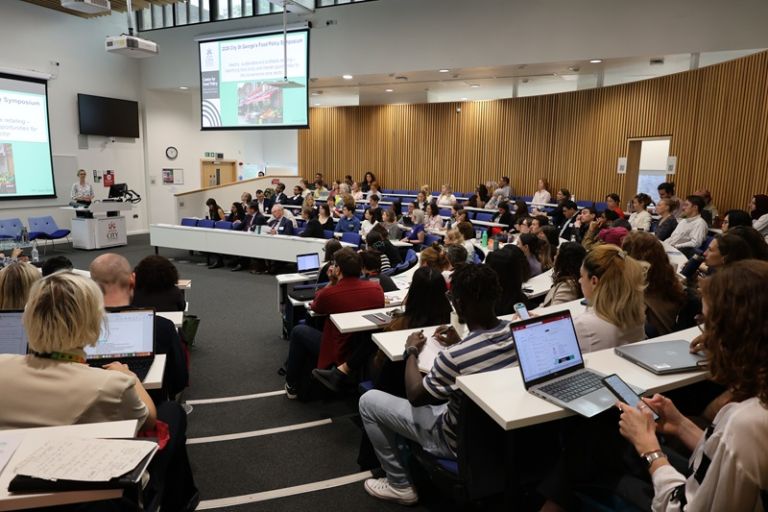
The Centre for Food Policy, in the School of Health & Medical Sciences at City St George’s, University of London, recently published its report on the City St George’s Food Policy Symposium 2025, which was held in May 2025.
The report highlights that professional cooks and chefs are vital food systems actors, responsible for feeding people across society from schools and care homes to restaurants and festivals, as well as manufacturing and designing our everyday foods.
Despite these vital roles, it concludes that professional cookery has been largely overlooked within food systems transformation, and that building the capacity of professional cooks and chefs to enact change is key to delivering a healthier, more sustainable, just and resilient food system.
Packed programme
The symposium itself featured a rich programme of plenaries and workshops exploring how building workforce capacity in professional cookery can contribute to resilience, health and sustainability, and it brought together over 200 attendees.
The keynotes were delivered by Thomasina Miers OBE, co-founder of Wahaca and a vocal advocate for sustainable food systems, and Baroness Joan Walmsley, Chair of the House of Lords Food, Diet and Obesity Committee 2024. During their keynote speeches, both highlighted that British food culture is dominated by convenience and ultra-processed foods (UPFs). This food culture is causing significant public health costs, they said.
Other speakers included experts from academia, industry, policy and the public sector, including representatives from the Centre for Food Policy, the Public Sector Catering Alliance, Chefs in Schools, NHS England, Hackney School of Food, and The Food Foundation.
Discussions focused on why we need to build capacity in professional cooking for food systems transformation, and the talks raised a number of policy actions that could be leveraged. A second plenary session, chaired by The Food Programmepresenter Sheila Dillon, tackled the question: “How can food policy support capacity building for cooks?”
Key recommendations
The key insights that emerged from the symposium are:
- Valuing the unique role of professional cooks in our food systems – The symposium highlighted that chefs and professional cooks hold a distinct and influential role within the food system and that their existing skills and knowledge offer a unique opportunity to support food systems change.
- Promoting the value of professional cookery in British food culture - The key role professional cooks and chefs can play in transforming British food culture away from reliance on unhealthy processed foods toward freshly prepared, plant-rich foods was repeatedly highlighted throughout the day. Examples of international best practice, innovative local initiatives and policy ideas all contributed to a pathway forward to food culture change.
- Reimagining education and training pathways for professional cookery - Training and education offer important avenues for increasing the value of professional cookery skills and supporting chefs to enact changes within the food system, but core curricula need updating and training pathways expanded and streamlined to build adequate workforce capacity.
- Coordinating thinking and actions to boost professional cookery’s role in food systems change - There is a wealth of innovative activity inspiring change across the professional cookery sectors, but a coordinated approach is urgently required to bring about coherent and effective changes in policy and practice.

Speaking about professional cooks and chefs and their role in the food system, Professor Christina Vogel, Director of the Centre for Food Policy, said:
“This topic is particularly important because it is not being discussed by policymakers. Cooking professionally in our schools, hospitals, prisons, restaurants, high streets – and in our food factories – is at its heart about nurturing people, and our food systems. Building the workforce capacity of teams working in kitchens and equipping them with skills and knowledge to address our current food systems challenges offers great co-benefits for policy, particularly in areas of skills, employment, health, the environment and economic growth.”
Looking ahead
The discussions from last year’s event continued at the City St George’s Food Policy Symposium 2026in June 2026. The 2026 edition explored how convenience stores can help improve access to healthier and more sustainable food while remaining commercially viable.
Read the full report on the City St George’s Food Policy Symposium 2025
Other stories you might like
-
Symposium explores the role of convenience stores in building healthier food systems
The Centre for Food Policy’s annual symposium examined what the UK needs to create a convenience store sector that benefits everyone.
-

Recommendations from City St George's professor included in new government report
Research by Professor Christina Vogel and colleagues on the placement of fruit and vegetables and enforcement of healthy food policies included in a new Health and Social Care Committee report
-

Many countries overusing powerful antibiotics
Global study produces first estimates of national levels of antibiotics needed to treat infection burden and to guide policy.


