

By Hamish Armstrong (Senior Communications Officer), Published
Building a food bank free future will require collaboration and intentionality across all sectors – including businesses, government, charities and communities – according to Heather Buckingham, Visiting Lecturer at Bayes Business School and Social Change Advisor at Trussell, as she launched her new book A Taste For Change: How to Build a Food bank Free Future (Bristol University Press 2026).
Food banks have become an increasingly normal part of life in the UK, a situation that has been exacerbated by a cost-of-living crisis hot on the heels of the global pandemic and rise in supermarket and fuel prices.
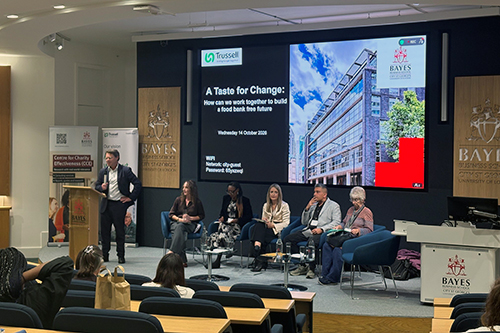
In a lecture, hosted by Bayes’ Centre for Charity Effectiveness, that drew on powerful perspectives from people who have used food banks and faced financial hardship, Heather outlined misconceptions about the reasons people access support from food banks. She explained how low income from employment, problems with the social security system and difficulties with mental and physical health often interact and exacerbate one another, leaving people unable to afford the essentials.
Heather argued that to bring about change, society must “loosen its grip” on the idea that simply trying harder will lead people to better financial outcomes. Instead, she called for a more compassionate approach to supporting people whose health or caring responsibilities prevent them working, and for political leaders to speak in ways that afford greater value and dignity to people in this position. At the same time, however, she proposed working concertedly towards a future where people “can make it if they try”. Lower paid employees, she explained, were more likely to have to reduce hours to balance work and family life due to a lack of flexible working, which eroded already-low incomes even further. Improving access and quality of work available to lower earners is therefore a crucial part of building a food bank free future too.
Following the lecture, Heather was joined for a panel discussion by experts from politics, charity leadership, business and lived experience perspectives, moderated by Professor André Spicer, Dean of Bayes Business School.
Kirstie Mackey OBE – Managing Director, Citizenship UK & Europe, Barclays
Rajesh Makwana BEM – Executive Director, Sufra NW London
Sharron Spice – Author, Playwright & Campaigner
Baroness Ruth Lister – House of Lords
The panel discussed some of the challenges associated with Universal Credit, a flagship element of the UK’s social security system. The lack of dignity that people often feel when engaging with the system was also highlighted as a particular problem. Sharron Spice described how the insufficiency of Universal Credit could lead to deteriorating mental and physical health, due to the stress of being unable to cover essential costs and to being unable to afford a healthy diet.
Rajesh Makwana pointed out that uneven distribution wealth contributes to food bank need because it directly impacts the housing market, meaning that many people are unable to afford a home. Meanwhile, Baroness Ruth Lister noted that the cost-of-living crisis has seen a growing number of people above the poverty line struggling to afford essentials at a time when income-based measures of the very deepest forms of poverty were also recording worrying increases.
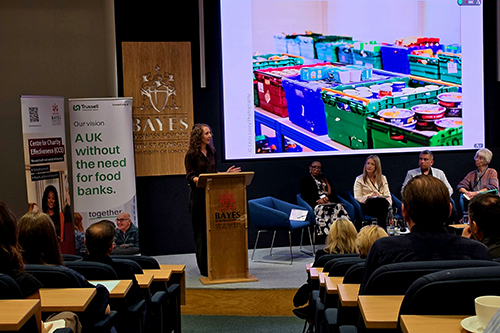
The panel discussed steps that responsible employers can take to reduce food bank need and noted that building confidence, as well as skills, is vital when it comes to supporting people to enter, or re-enter, the workforce. Financial inclusion initiatives that help people accessing food banks ensure they are receiving eligible social security were highlighted as an effective way of making it less likely that people will need to return to the food bank.
An audience Q&A followed, exploring topics such as innovation, best practice and the role of education in challenging the next generation of business leaders to tackle societal issues like poverty.
The panel discussed steps that responsible employers can take to reduce food bank need and Kirstie Mackey emphasised that building confidence, as well as skills, is vital when it comes to supporting people to enter, or re-enter, the workforce. Financial inclusion initiatives that help people accessing food banks ensure they are receiving eligible social security were highlighted as an effective way of making it less likely that people will need to return to the food bank.
An audience Q&A followed, exploring topics such as innovation, best practice and the role of education in challenging the next generation of business leaders to tackle societal issues like poverty.
On delivering the lecture, Heather Buckingham said:
“Ending the need for food banks requires a cross-society effort and collective responsibility from policymakers, businesses and communities.
“To develop a society where everybody can afford the essentials, the Government needs to align the basic rate of Universal Credit with actual living costs. Employers must also play their part through creating jobs that not only pay sufficiently but also offer flexibility and predictable working hours wherever possible, while communities need to become contexts in which people increasingly have the kinds of supportive relationships that reduce social isolation and ensure people access support before a crisis develops.
“In writing A Taste For Change, I wanted to encourage each of us to consider the kind of society we need to become if we are to end the need for food banks. My thanks go to Bayes for hosting tonight’s discussion, and I hope the conversations it prompts moving forward prove to be catalysts for change.”
Dr Angela Ellis Paine, Lecturer in Voluntary Sector Management, said:
“The need for food banks is a complex challenge in the UK, but one that is solvable. Heather’s book lays out a blueprint for change and is an essential read for everyone, including those with the ability to turn the tide on inequality in this country.
“The event drew lively discussion, ideas and an appetite to remove hurdles and strive for a fairer society.
“At the Centre for Charity Effectiveness, we aim to drive transformation in the not-for-profit sector and deliver sustainable change through our training, events, consultancy and applied research. We work to support cross-sector collaboration in the belief that we need to work together to tackle key societal challenges. Our thanks go to Heather and Trussell for delivering such an engaging and important discussion.”
Other stories you might like
-

“This is the start of something”: New text explores the concept and history of benefit concerts
Bayes Centre for Charity Effectiveness expert launches new book, Rock for Change.
-

Lord Simon Woolley delivers 2026 Craft Lecture
Founder of Operation Black Vote calls for boldness in annual Bayes flagship talk.
-
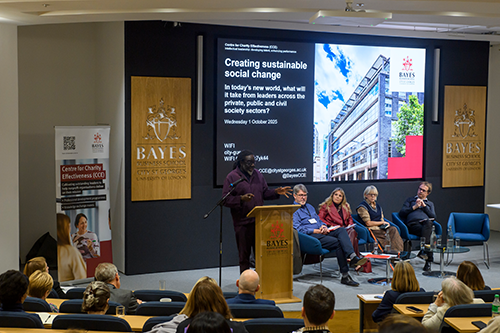
Charity leaders need more than good intentions, peer says
Bayes' CCE hosted a panel discussion on charity, public and private sector leadership that can deliver sustainable social change.