

By Hamish Armstrong (Senior Communications Officer), Published
How do concerts, tours, and recordings mobilise musicians to raise money or awareness for social problems? This is the question Dr Peter Grant, Senior Lecturer in Management at Bayes Business School attempts to answer in the newly published title Rock for Change (Bloomsbury 2026).
Concerts have long been used as a means of fundraising ever since George Harrison and Ravi Shankar staged the first recognised event – The Concert for Bangladesh in Madison Square Garden, New York City – in 1971.
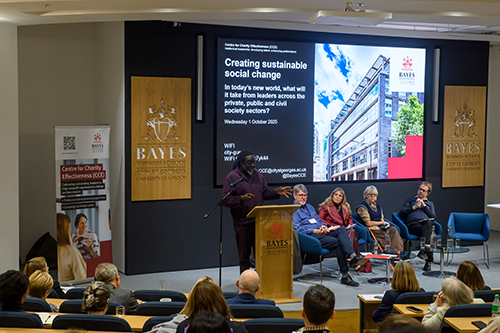
In a launch at Bayes, Dr Grant and his co-author, Nick Baxter-Moore, offered reflections on their research into compiling the text to the backdrop of audio from some of the most prominent benefits concerts in history.
Contributors presented on the significance of historic concerts of different scale, from large global phenomena like Live Aid and major national events to so-called ‘micro-campaigns’ such as ‘Rock Against Racism’ and commemorative concerts raising awareness rather than funds.
Chapters of the book explore the impact of benefit concerts on society’s charitable behaviours through different generations and political movements. Themes include a comparison of successful types of concert, how concerts have reflected popular music of the time (or otherwise) and how organisations select artists to perform while navigating political factions.
Following presentations from the book's contributors, Stephen Greene CBE, CEO and co-Founder of RockCorps – an organisation combining music and volunteerism founded in the wake of 9/11 – spoke about his inspiration behind the platform that has delivered large concerts in recognition of voluntary work featuring artists like Lady GaGa and Rihanna.
Stephen recounted the lessons he and his co-founders had learned from Live Aid and the challenges of putting on a benefit concert, all leading to the question of whether they could put on a concert that rewarded time rather than money. He also spoke about “intrinsic motivation” that drives volunteers and the presence of brands in social movements.

Dr Grant said:
“This is one of the longest-running projects I’ve been involved with.
“Various connections between politics, popular music and social campaigns have been well documented, but our aim was to bring this literature together to provide a definitive history and analysis of the benefit concert and how it has evolved.
“The text contains enlightening accounts of why certain concerts failed, while others raised significant funds without generating sufficient social change. Key learnings point to diversity and the identity of artists fronting certain movements, targeting of the correct demographic to generate funds and awareness, and striking a balance between shock factor and controversy – without the risk of appearing purely performative.
“Nick and I are very proud to see the text finally in print, and would like to extend our gratitude to all contributors, to Stephen and to the Centre for Charity Effectiveness for its support.”
Rock for Change is available to purchase as both a hardback and e-book. Contributing authors include:
- Dr Peter Grant
- Nick Baxter-Moore
- Marc Percival
- Jeremy Tranmer
- Scott Henderson
- Kirsten Zemke
- Heather McIntosh
- Kip Pegley
- David Wright
- Chris McDonald & Heather Sparling
Read more about the Centre for Charity Effectiveness at Bayes Business School.
Other stories you might like
-

Professor Chris Dayson appointed Director of the Centre for Charity Effectiveness
“When students, alumni, consultants, academics and sector partners come together, it is amazing how much we can co-create real world impacts for policy and practice through meaningful applied research
-
Charity leaders need more than good intentions, peer says
Bayes' CCE hosted a panel discussion on charity, public and private sector leadership that can deliver sustainable social change.
-

Philanthropy among wealthiest donors is increasing but better financial advice is needed, finds new report
New research co-authored by Bayes Business School for Barclays examines trends in UK philanthropy.