
City St George's and the UEA launch the results of the International Media Freedom Support (IMFS) index for 2026.
By Eve Lacroix (Senior Communications Officer), Published
Sweden has been ranked the world's leading supporter of international media freedom, according to a new index published today.
The index also highlights a decline in funding from 30 leading donor countries, despite growing threats to independent journalism worldwide.
The Index on International Media Freedom Support (IMFS) evaluates countries on how actively they support media freedom beyond their borders through diplomatic, funding and safety efforts.
It is published annually by an independent team of academics City St George’s, University of London and the University of East Anglia (UEA).
Sweden topped the 2026 Index - moving up one place from 2025 - largely due to its significant financial support for international media development.
In 2024, Sweden spent 1.01 per cent of its total aid budget on supporting independent journalism around the world.
However, Sweden is an outlier. Across all 30 countries in the Index, just 0.15 per cent of official development assistance (ODA) was allocated to media support in 2024, down from 0.16 per cent in 2023.
Three countries gave no money at all to international media development – despite having pledged to support promote media freedom internationally: Latvia (18th), Greece (24th) and Slovenia (29th).
The Index was launched on Wednesday 25 November at an event in Westminster hosted by the All-Party Parliamentary Group (APPG) on Media Freedom, in partnership with Reporters Without Borders (RSF), which serves as the APPG's secretariat.
Speakers included Rt Hon Sir John Whittingdale OBE MP, Chair of the APPG on Media Freedom; Elin Norqvist, Counsellor for Cultural Affairs, Embassy of Sweden; Sirpa Nyberg, Deputy Head of Mission, Embassy of Finland; Professor Mel Bunce (City St George’s); Professor Martin Scott (UEA); Felicity Garvey, UK Advocacy Manager, Reporters Without Borders (RSF).
Mel Bunce, Professor of International Journalism and Director of the Centre for Journalism & Democracy at City St George’s, highlighted the progress made by some countries, adding: “Finland recorded the largest improvement in the rankings between 2025 and 2026, climbing nine places from 19th to 10th.
“This was largely driven by its increased leadership role in international efforts to support media freedom, including taking on the role of co-chair of the Media Freedom Coalition, an international coalition of 50 states.”
Fellow report co-author Martin Scott, Professor of Media and Global Development at the UEA, said: “At a time of growing geopolitical instability and mounting pressure on independent media, international support should be increasing, not declining.”
The United Kingdom, the Media Freedom Coalition’s other co-chair, maintained its 12th-place ranking, reflecting its continued diplomatic engagement on media freedom.
UN Special Rapporteur on freedom of opinion and expression, Leopoldo Maldonado Gutiérrez urged states to “use these findings as an opportunity to strengthen cooperation, protection and sustainable support for independent journalism”.
Sweden’s Ambassador to the UK, Stefan Gullgren, said that “freedom of expression and the right to information are pillars in our democratic global community and the media workers are at the forefront. We would be delighted if we could share first place with many more nations; this is not a race to win, but a shared endeavour”.
The IMFS is the only index to evaluate countries' foreign policy support for media freedom. It includes all 30 countries that are members of both the OECD Development Assistance Committee and the Media Freedom Coalition.
The Index draws on 2025 data for diplomatic and safety measures, with financial data from 2024 due to reporting lags.
It is published by the Centre for Journalism and Democracy at City St George’s, which investigates the threats facing journalism, the impact of these on civil life, and designs interventions to help address them.
The centre partners with journalists, thinktanks, NGOs, and policymakers to explore how ethical, public interest news can be reimagined and protected for future generations.
Related schools, departments and centres
Other stories you might like
-
Baltic countries lead the way in supporting media freedom internationally, according to new index
The Centre for Journalism and Democracy launches a new Index on International Media Freedom Support.
-

“Solid fact has cracked”: the 2025 UK Media Freedom Forum makes plain how attacks on journalism are affecting democracy
City Journalism cohosts the Media Freedom Forum 2025, along with the Foreign Policy Centre, Justice for Journalists and International Bar Association’s Human Rights Institute.
-
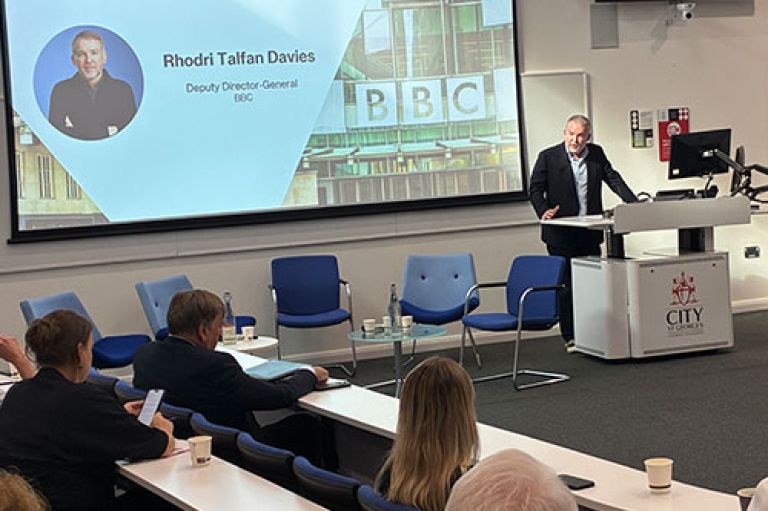
Beyond Britain: The Global Value of the BBC
As the BBC prepares for Charter renewal, broadcasters and academics warn that trusted public service media is becoming more important in an era of disinformation, geopolitical tension and declining fu
-

Decline in media freedom ‘hand-in-hand’ with democratic backsliding
Professor Mel Bunce writes for the Foreign Policy Centre about the decline of media freedom and democracy, as part of a collaborative miniseries about the drivers of global disorder.


