

Cultural criminologist and vinyl-head Dr Lambros Fatsis launches book exposing the racist policing of Black music.
By Eve Lacroix (Senior Communications Officer), Published
“Police racism is not a system error. It is a default setting,” says Dr Lambros Fatsis, cultural criminologist at City St George’s, University of London.
Earlier this year, a report found Black children were eight times more likely to be strip-searched than white children.
A review of the Metropolitan Police found it to be structurally racist, with a report from the Independent Scrutiny and Oversight Board earlier this year finding its Police Race Action Plan wanting.
According to Dr Fatsis, police racism extends beyond stop-and-searches into the fabric of Black culture, as seen through the criminalisation of Black and Afrodiasporic music.
His new book Policing the beats explores how music has been used as an instrument for policing Black people, from the era of colonial slavery to the present day and reveals the racist legal processes that make crimes out of rhymes.
How music became criminalised
It is within his musical community that Dr Fatsis developed his cultural politics.
Alongside his academic life, Dr Fatsis is a lifelong vinyl-head and sound system fan, and deejays with the UK collective Boulevard System, playing reggae and dub.
These genres – and more modern ones, such as drill, which is a subgenre of rap – have evolved through Black and Afrodiasporic communities in the UK.
When UK drill music began booming in popularity in the 2010s, the rap subgenre was portrayed as a criminal enterprise in headline media.
His love of the music, and a serious of high-profile cases in which rap lyrics were used against drill music artists in court cases pushed him into activism in this area.
He joined Art Not Evidence, a group campaigning to make it illegal for music lyrics to be used as evidence in courtrooms, on the basis that it criminalises an art form.
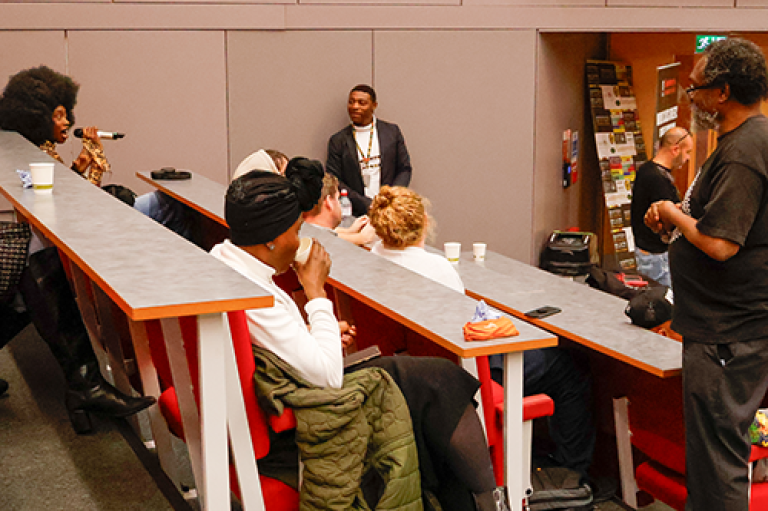
His new book is a continuation of that campaigning, and he launched it at Rarekind Records in his home city of Brighton.
He describes Rarekind Records as “a record shop that does not just sell round discs of plastic, but is a live library of ideas that offer a sound education.”
“I couldn't feel more humbled, honoured, grateful and elated than casting my mind back to my book launch event Rarekind Records,” he said. “It's in places like this that my aesthetic formation, cultural politics and ethical conscience was shaped.”
The history of the police as imperial militias
Dr Lambros’ book argues that the issue of racism in policing stretches back to its origins. He said:
Related schools, departments and centres
Other stories you might like
-

“Be alert to how governments transform human rights into criminal offences”: Dr Lambros Fatsis responds to charges against Kneecap's Mo Chara
City sociologist discusses the ethical questions surrounding the recent terrorist charges of a member of the rap group Kneecap.
-

“We continue to fight for our minds”: Art Not Evidence makes the case against using drill lyrics as evidence in court
Dr Lambros Fatsis curates event "Art Not Evidence: All Angles" to discuss why drill music lyrics should not be used in court as evidence.
-
Black Music Congress returns to City St George’s
City St George’s hosted the return of the Black Music Congress, bringing artists, academics and industry figures together to reflect on the legacy and lasting influence of British Black Music


