

Dr Samford Wong works at City St George’s with the Acute and Critical Care Research Group, which focuses on understanding how health conditions, treatments and interventions affect patients and their families
Dr Samford Wong, an Honorary Reader at City St George’s, University of London, has been awarded the Professional Achievement honour by the British Dietetic Association (BDA), recognising more than a decade of outstanding contributions to nutrition and spinal cord injury care.
The award celebrates Dr Wong’s sustained impact on evidence-based practice, research leadership and national and international collaboration in the field of spinal cord injury (SCI) nutrition. Alongside his clinical role as Consultant Dietitian (Spinal Injury and Neurorehabilitation) at The Royal Buckinghamshire Hospital, his academic work is closely linked to City St George’s through the Acute and Critical Care Research Group, which focuses on understanding how health conditions, treatments and interventions affect patients and their families, and how these can be improved to enhance outcomes.
Dr Wong works closely with colleagues in the Department of Population Health and Policy, helping to strengthen the University’s role in advancing translational research that bridges clinical practice and academia.

Reflecting on receiving the award, Dr Wong said:
“I am delighted to have received the Professional Achievement honour. It’s like a stamp or approval of what I have achieved, especially as most of my career has been based in a non-teaching hospital which lacks an academic department or sponsored research posts. I am lucky to have met and linked up with some really nice academic colleagues (then friends) from top universities. I wouldn’t be here without their support.”
Dr Wong developed an early interest in spinal cord injury and rehabilitation, which shaped his career trajectory and research focus. Through his PhD, he built expertise in translational research, ensuring that nutritional science directly informs patient care.
“Most of my patients sustained a spinal cord injury, a catastrophic condition that causes permanent disability,” he said. “I really enjoyed it when my intervention made a difference to people’s health.”
A key highlight of Dr Wong’s career has been his leadership within the International Spinal Cord Society (ISCoS), where he was the founding chair of the Nutrition Special Interest Group. The group, which also involves Dr Shashi Hirani from City St George’s, now includes more than 50 members from 14 countries and a wide multidisciplinary mix of clinicians and researchers.
“Prior to that, nutrition and dietetics tended to be forgotten in the wider MDT, as the primary focus was restoring physical function after spinal cord injury,” he said. “Nutrition plays a crucial role in the health and recovery of people living with spinal cord injuries and disorders.”
Related schools, departments and centres
Other stories you might like
-

TANGO showcase highlights importance of support for people with acquired brain injury
Researchers, clinicians, and people with lived experience came together to share insights and shape future support for those with cognitive communication difficulties
-
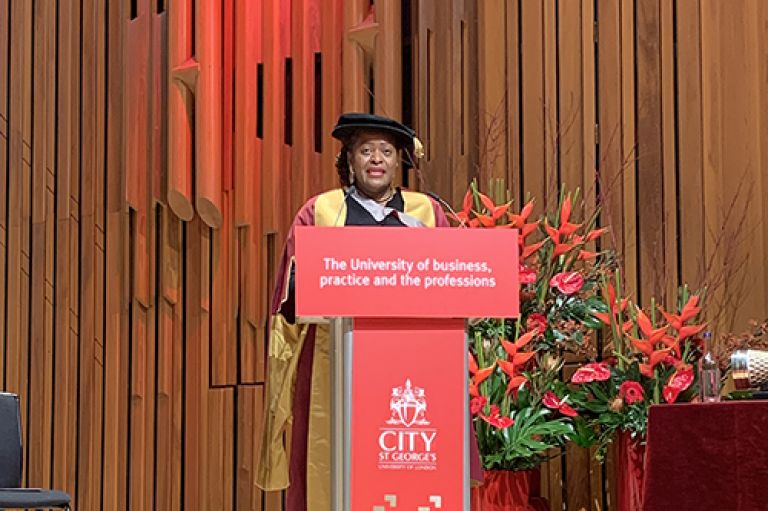
Lorraine Sunduza OBE awarded Honorary Doctor of Science degree
The CEO of the East London NHS Foundation Trust, Lorraine Sunduza OBE, received an Honorary Doctorate from the School of Health & Medical Sciences at City St George’s latest graduation ceremony.
-

Strong link between high-engagement gambling and suicidality
Findings highlight the urgent need for targeted interventions and greater awareness of the heightened risks among people who engage regularly in a wide range of gambling types


