

By City Press Office (General enquiries), Published
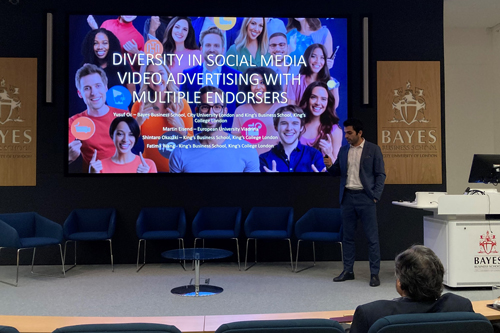
Four draft white papers – each organised around one of Bayes’ cross-cutting strategic themes and supported by 14 detailed sub-theme documents – were presented at our recent Research Day.
Together, they showcased the School's current research outcomes and ambitious future agenda across:
- Adapting to a transforming world
- New technology and innovation, with a special focus on AI
- The future of finance and insurance
- Tackling societal challenges.
Associate Dean for Research, Professor Feng Li, said: “With colleagues joining throughout the day, the event created a genuinely stimulating atmosphere, sparking lively debate, constructive challenge and thoughtful questions. That spirit of engagement reflects the collaborative ethos we are cultivating through our four cross-cutting research themes.
“Bayes has always encouraged a thousand flowers to bloom, and we will continue to support individual creativity. But many of the complex challenges we face today are simply too big for any one scholar to tackle alone. That is why we need to build new research partnerships – across faculties, across disciplines, and with the wider City St George’s community, including our expanded School of Health and Medical Sciences. By working together, we can harness our collective expertise to make a real impact."
World in flux
During the morning session, colleagues explored how the world is changing, and the impact technical innovation such as AI and global geopolitical shifts are having on perceptions of research expertise, organisational strategies, supply chains and the way businesses operate.
Following an introduction from Professor Zach Estes, Research Director for the Faculty of Management, Dr Itziar Castelló and Dr Joelle Evans presented their work investigating how disinformation and the “erosion of expertise” has affected society. Professor Daniel Beunza outlined how businesses and policymakers are being affected by such a rapidly changing environment, before Dr Sara Jones gave insights into her recent work in Ghana, and how developing nations are responding to global shifts.
Professor Meziane Lasfer concluded the opening session by outlining research around how businesses are mitigating geopolitical risk through robust financial and global supply chain strategies.
During the afternoon, colleagues explored how organisations are harnessing AI and innovation to develop their capabilities. After a brief overview of this theme by Professor Li, Professor ManMohan Sodhi explored how technology are affecting business and logistics across supply chains and operations, while Dr Jafar Sabbah presented the changes that AI is bringing to the workplace and workforce.
AI and art
To end the session, Dr Jones again took to the stage to share her explorative research of artists’ use of generative AI – including the production of content and ideas, and the increasingly innovative processes behind them. She was joined by Dr Eugenia Cacciatori, who outlined how AI changing the nature of research & development and academic research – with a decline in the need for “physical” experimentation.
Introducing the afternoon session, Professor Pawel Bilinski, Research Director for the finance part of the Future of Finance and Insurance theme, exhorted colleagues to talk to academics outside their own faculty. Professor Bilinski addressed sub-themes around the future of accounting, corporate finance and the application of AI – and, on behalf of Drs Andrew Yim and Simon Parker, addressed ESG disclosure and sustainable finance.
Speaking on ‘the future of banking’, Professor Vasso Ioannidou said banks are working in an environment where new opportunities are also challenges. Her list of these double-facing factors included:
- Technological innovation
- Financial regulation
- Economic uncertainty
- Policy uncertainty
- Geopolitics
- Fragmentation.
Professor Ioannidou and her colleagues in the Bayes Centre for Banking Research are exploring topics ranging from how stablecoins are affecting system stability, the role of tech innovation in speeding up SMEs’ access to credit, and banking's role in mitigating climate change, and misconduct in the sector. Professor Ioannidou and Dr Francesc Rodriguez Tous are exploring how changes in monetary policy affect bank lending and the investment decisions of other financial institutions, such as pension funds.
The centre's work is based around five themes:
- Digital transformation and new frontiers in banking
- Digitalization, runs, and cyber resilience
- Monetary policy, financial institutions, and the real economy
- Sustainable and inclusive banking
- Societal role of banks.
Dr Simone Krummaker, the newly-installed Head of the Faculty of Actuarial Science and Insurance, acknowledged that she and colleagues are still refining the research agenda around the future of insurance. However, she said that other presentations during the day had identified that “insurance is an inherently interdisciplinary subject” and the sector could comfortably be a sub-theme in many of the studies already planned or underway.
She also highlighted, however, faculty projects ranging from Professor Andreas Tsanakas’s work on fair pricing to analysis of the sector’s role in enabling the transition to a sustainable economy and society.
Dr Eugenia Cacciatori, from the Faculty of Management, is exploring public private partnership insurance schemes between industry and governments as climate change-related extreme weather events make conventional cover unviable.
Other projects underway or planned include:
- Partnerships and Collaboration for increasing resilience and insurability
- The role of AI/tech in enabling sustainable insurance solutions
- Professionalism in Insurance
- The Implications of ‘Green Seaworthiness’ on the Insurability of Global Maritime Risk
- The role of trade and export credit insurance and finance to drive the green transition
- GHG/Carbon accounting in public finance and insurance organisations.
The final theme, Tackling Societal Challenge, was introduced by Professor Rosalba Radice. Dr Ioannis Moutzouris then took the floor to discuss several large externally funded projects he is leading and areas for future collaborations. He was followed by Dr Radice who addressed several critical issues around health and ageing, and some externally funded projects she leads.
In their closing remarks, University Vice-President Professor Jon Friedland and Bayes Executive Dean Professor André Spicer emphasised the rapidly changing landscape of higher education and the new opportunities this creates for multidisciplinary research, particularly in relation to the four strategic themes.
They urged Bayes academics to take the initiative in addressing some of the most pressing challenges facing business and society today. Professor Spicer noted that the event and the white papers together reflected the ‘rich tapestry’ of Bayes research and reinforced the School’s ambitious and sharply focused research agenda.
Other stories you might like
-

Partnership working top of Bayes' research agenda
Bayes Research Day emphasises interdisciplinary opportunities at City St George's
-
Ideas fizz at School Research Day
Bayes researchers outline projects and studies on school research day
-
Bayes Research Day: The value of research and collaboration
Bayes Business School hosts inaugural research day to share projects in progress and discuss the benefits and challenges of greater collaboration.