

By City Press Office (General enquiries), Published
Interdisciplinary working across the newly expanded City St George’s University was the focal point of the Bayes Business School Research Day this week.
Opening the event, Bayes Associate Dean for Research, Professor Feng Li, outlined the School’s four cross-cutting research themes:
- Alleviating societal challenges
- The future of finance and insurance
- Technologies and innovation, with a particular focus on AI
- Making sense of the transforming world.
Acknowledging the broad scope of these themes, Professor Li said: “Engaging with business and the professions is an important part of our strategy. Take the future of finance theme: we want to be the intellectual hub for the City of London. We are already doing a lot of exciting work in these areas, but there are emerging issues that need further exploration – to improve understanding and influence practice and policy in those spaces.”
Gaze beyond Bayes
The University’s Vice-President for Research, Professor Leanne Aitken, outlined the additional support planned for the academic year, encouraging academics to explore collaboration opportunities with colleagues across other schools.
She emphasised the value of interdisciplinary research, saying: “Interdisciplinary research offers unique – and often more impactful – solutions to societal problems. Many of these challenges are addressed by the School’s four research themes.”
While commending the high quality of Bayes research, Leanne urged colleagues to consider factors such as external research funding, impact, and stakeholder engagement when planning their work.
The event continued with a Panel Discussion on key issues related to the School’s four cross-cutting research themes. Professors Scott Moeller, Canan Kocabasoglu, Vladimir Kaishev, Neil Maiden and Bobby Banerjee explored ongoing research and emerging opportunities, offering insights into alleviating societal challenges, the future of finance and insurance, AI and innovation, and how to navigate a rapidly transforming world.
Associate Deans for Research & Enterprise from across City St George’s outlined the research focuses of their respective schools.
Professor Steven Gillard from the School of Health & Psychological Sciences discussed the need to evaluate roles within the health workforce, aligning research with the priorities of Wes Streeting, the new Secretary of State for Health and Social Care.
Dr Lea Hellmueller from the School of Communication & Creativity spoke about the declining trust in journalism amidst growing competition for audiences, as well as safeguarding media freedom and information. Professor Inderjeet Parmar from the School of Policy & Global Affairs highlighted the newly formed Finsbury Institute as a key player in addressing the global ‘polycrisis’, and Professor David Townend from The City Law School summarised the role of sociolegal philosophy and the law-making process in their research activities, focusing on the consistency of law.
Tasters from a futuristic menu
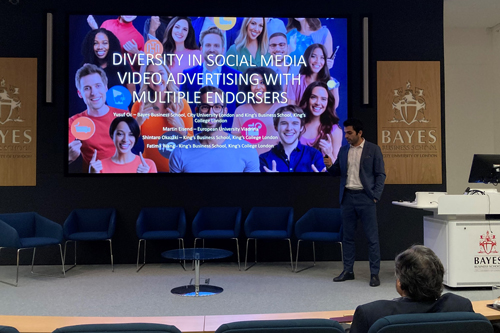
The afternoon saw 20 rapid-fire presentations showcasing the rich research at Bayes. The first session focused on Innovations in AI and the Future of Finance, with contributions on topics such as shipping energy efficiency, SME business models, machine learning in finance and the impact of climate and political uncertainty on Europe’s electricity markets.
The second session, chaired by Professor Pawel Bilinski, addressed societal challenges in a rapidly-changing world, covering issues such as career changes, innovative systems for healthcare workforce deployment, supply chain imbalances and the perceptions of premium brand consumers.
The Dean, Professor Andre Spicer, delivered the closing remarks, highlighting the importance of interdisciplinary work in addressing the significant challenges facing business and society. While recognising the School’s strong tradition of individual research excellence, he encouraged Bayes colleagues to collaborate more both within the School and across the University, aiming for increased external funding and a greater impact on policy and practice. He also reflected on his favourite part of the day – the rapid-fire presentations, which showcased the breadth of research at Bayes, ranging from societal inequality to the role of AI in healthcare, and solutions to global challenges such as energy crises and leadership transitions in business.
Other stories you might like
-
Ideas fizz at School Research Day
Bayes researchers outline projects and studies on school research day
-

Bayes Research Day: The value of research and collaboration
Bayes Business School hosts inaugural research day to share projects in progress and discuss the benefits and challenges of greater collaboration.