
The Sustainability Annual Report showcases the University’s contribution to the Sustainable Development Goals
Published
City St George’s has launched its annual sustainability report as the city marks London Climate Action Week.
The 2024 Sustainability Annual Report is an account of the University’s progress toward sustainability and showcases how the City St George’s community is responding to one of society’s greatest challenges.
City St George’s has also launched a Sustainability Strategic Transformation programme which aims to embed sustainability across the institution, from curriculum design to carbon reporting.
Professor Richard Ashcroft, Senior Leadership Team lead for Sustainability and Chair of the Sustainability Board, said he was proud to share the University’s achievements in the report.
Global Goals
The annual report reveals the ways in which the University has aligned its efforts with the Sustainable Development Goals, also known as the Global Goals. The goals are a universal call to action by the United Nations to end poverty, protect the planet, and ensure peace and prosperity for all by 2030. Comprising 17 interconnected goals, they offer a comprehensive framework that encourages governments, businesses and civil society to work together toward a more equitable, inclusive and sustainable world.
Here some of the ways City St George’s is working to create meaningful change through innovation and partnership with this shared agenda:
Education: the creation of a new interdisciplinary sustainability module
The ‘Sustainability and Climate Change’ module will be led by Dr Jed Odermatt and taught by academics throughout the University’s schools and departments. Through this innovative and collaborative approach, students will examine the scientific, economic, cultural, legal, moral and ethical dimensions of sustainability and climate change. They will work in groups to address a real-world challenge set by an external partner and develop skills in critical thinking, problem solving and using technology. The project was the successful recipient of a Teaching and Research Award from the University of London’s Centre for Online and Distance Education (CODE). This CODE award will enable the team to study the impact of the module’s innovations, including group work assessment. Initially offered to law students, the aim is to widen the module to other programmes in future years.
Research: Indigenous perspectives on biodiversity
Since colonisation, land has been used primarily for capital accumulation through activities like mining and industrial agriculture. In contrast, Indigenous peoples have profoundly different relationships with the land, which are more relational. Addressing the imbalance of Western conservation policies which fail to address Indigenous knowledge and approaches, Professor Bobby Banerjee of Bayes Business School worked with Associate Professor Diane-Laure Arjaliès of Ivey Business School, Canada to elaborate on a community-based participatory project with the Chippewas of the Thames First Nation community in Canada.
The Conservation Impact Bond project was unique as it combined Indigenous and Western knowledges and aimed to restore ecosystems by rebuilding relationships between people and the land based on kinship.
Engagement: student volunteering at City St George’s
The Volunteering service works with over 140 organisations to provide students with opportunities to drive positive change for causes they care about.
Student volunteers are keenly engaged in education-based volunteering, bringing their knowledge and skills to roles supporting disadvantaged children across London and supporting young people in academic and personal development.
The University has expanded the number of education charities it works with and has welcomed new partnerships with Light Foundations, BeScience STEM and Cyber Champions among others.
Healthcare is consistently a top area of interest, with 40 partner organisations offering volunteering roles to students so they can support healthcare institutions and patients alongside their studies. Opportunities include befriending, hospital support and health research. Students have also worked alongside staff to improve local green spaces around campus. These efforts contribute to cleaner, greener spaces for the local community.

Operations: university joins sector-wide project to tackle supply chain emissions
The Net Zero Carbon Supplier Tool was developed by Nottingham Trent University, in collaboration with NETpositive Futures, to support the development of sustainable supply chains and advance the higher education sector’s progress toward net zero.
In response to carbon reduction ambitions, legacy City joined the project in order to improve its understanding and implementation of available methods for measuring and monitoring certain emissions, with a particular focus on ‘Purchased Goods and Services’. The data gathered is critical in informing and shaping the strategy of the University to reduce emissions.
In the recently announced Times Higher Education Impact Rankings, which ranks 2,526 universities from 130 countries or territories based on their progress towards the Sustainable Development Goals, City St George’s was ranked in the 301-400th position. For the goal of Industry, Innovation and Infrastructure, the University ranked 101-200th and ranked 201-300th for Reduced Inequality.
Other stories you might like
-
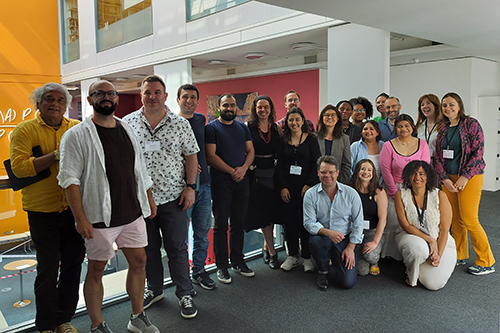
Talking sustainability: Bayes experts provide early-career mentoring
Bayes hosts workshop for junior and aspiring academics from across the globe.
-

City St George's strengthens research ties with Malaysia
A high-level delegation from Malaysia recently visited City St George’s to strengthen research ties and build upon the existing collaborative initiatives in affordable diagnostics.
-
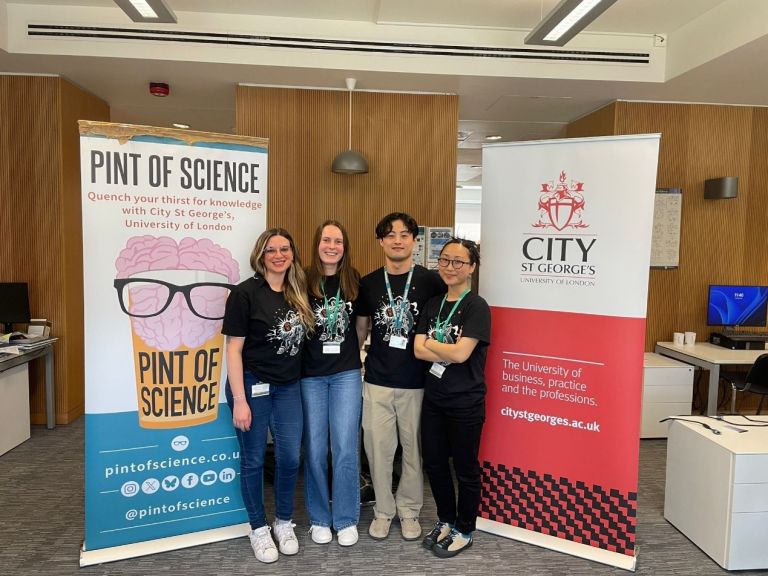
City St George's Pint of Science Event 2025
Bringing science to the pub! City St George’s proudly joined the global Pint of Science festival, sharing groundbreaking health and medical research from Tooting with the local community.

