

By Hamish Armstrong (Senior Communications Officer), Published
Even the most promising technologies can fail to take off if governments, producers, suppliers, consumer and business demands are not able to support their growth, according to new research by Bayes Business School.
The paper, co-authored by Dr Mara Guerra, Senior Lecturer in Strategy at Bayes and Professor Rajshree Agarwal, University of Maryland, compared respective development pathways for silicon and thin-film technologies that grew the US solar photovoltaics (PV) industry between the 1950s and present day.
For many years, both technologies had their own strengths. Thin film had lower per unit-cost and versatility while silicon also benefited from falling costs and innovation, and there was no obvious frontrunner. However, when demand finally took off in the late-2000s, silicon was in a better position to meet utilities’ requirements at scale, reliably and cost-effectively.
The virtuous cycle of events that pressed home silicon’s advantage is identified by the researchers as a ‘reinforcement loop’. Established supply chains and manufacturing equipment helped silicon’s achieve scale, which then enhanced reliability, reputation and cost efficiency. This in turn attracted further interest, investment and demand.
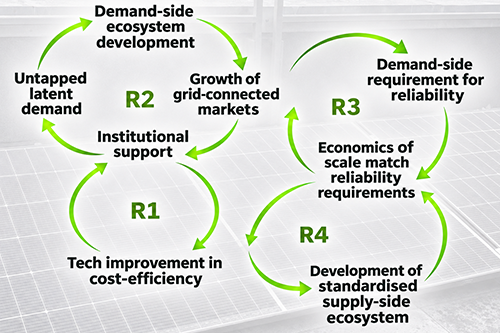
By contrast, thin film had more customised supply chains and weaker economies of scale, making it less reliable and financially unsustainable, and led to a queue of market exits from investors and producers. Thin-film technology, according to the study, had been slowed down by ‘balancing loops’.

At the end of the study period in 2020, silicon accounted for 91% of solar PV industry sales. While a similar number of solar cell producers entered into each technology during the period studies, three quarters of thin-film companies exited – paving the way for silicon to dominate.
The research comprehensively explored a large range of industry news coverage, reports, market entrants strategies, government interventions, and investment history to uncover patterns and interdependencies with the fortunes of the two competing solar panel technologies.
Dr Guerra said:
“Our research strongly suggests that technologies do not just appear through innovation, but rely on interaction between a much wider group of actors, from manufacturers and equipment suppliers to governments, utilities and financiers.
“Silicon did not simply win the battle because it was the better technology. It won because it was better equipped to take advantage of an ecosystem that had developed around solar power as demand began to take off.
“Silicon solar PV’s success has important wider implications for other emerging technologies. Developing a viable technology is only a small part of the challenge. Businesses and policymakers also need to understand whether the wider ecosystem – investors, activists, policymakers, consumers – is ready to support it at scale.”
‘Technology (Non)Emergence: How System Interdependencies Among Activities by Heterogeneous Actors Shaped Alternative Solar Technology Trajectories’ by Dr Mara Guerra and Professor Rajshree Agarwal is published in Organization Science.
Other stories you might like
-

From incubation to impact: new framework illustrates how industries are created
Bayes literature review explores the creation and growth of nascent industries.
-

Research links poor management to higher work intensity
Bad bosses could be worsening UK mental health crisis, according to a new study from Bayes Business School.
-

Bayes lays out research’s role in addressing global challenges
Bayes publishes white papers outlining how research will address national and global challenges