

By Hamish Armstrong (Senior Communications Officer), Published
Experts from Bayes Business School have established a new institute to advance policy, research and practice in the application of artificial intelligence (AI) across government and public services.
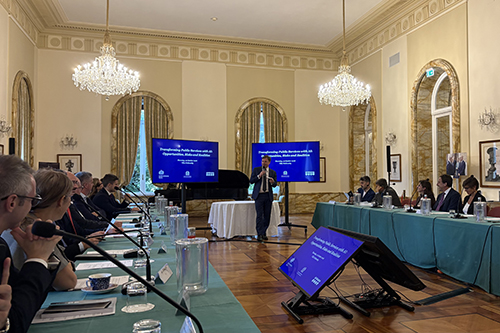
The International Institute for AI in Government (IIAIG), founded by Jeremy White, Honorary Visiting Professor at Bayes and Massimiliano Filippi (Executive MBA 2023), was officially launched at a conference hosted by Stephen Hickey, British Ambassador to Italy, at his residence in Rome.
The Institute brings together an international academic advisory network with members from Bayes, the European University of Rome, the University of California, Los Angeles (UCLA), and Columbia University in New York. Its central objective is to help public authorities harness AI to improve the quality, accessibility and efficiency of services while addressing the challenges of governance, accountability, transparency and public trust.
Work of the Institute will focus on developing practical insights, supporting informed policymaking and sharing international evidence and best practice in AI adoption. It will develop research and policy analysis, encourage collaboration between academic institutions and public authorities, and publish regular briefings on developments in AI in government internationally.
The official launch of the Institute took place during a conference titled ‘Transforming Government: AI for Smarter, More Productive Public Services’, hosted by Ambassador Stephen Hickey and attended by representatives of Italian public authorities, UK government AI specialists, academics and business leaders. Professor White and Mr Filippi helped organise the conference and led discussions examining practical applications of AI, the institutional challenges of implementation and opportunities for closer cooperation between the UK and Italy.

Professor White said:
"Artificial intelligence offers governments an extraordinary opportunity to improve public services, but the challenge is no longer simply technological. Governments need the institutional capacity, governance frameworks and practical knowledge to translate advances in AI into measurable improvements for citizens.
“Our Institute has been established to help bridge the gap between research, policy and implementation. By bringing together academic expertise and practical experience across countries, we aim to identify what works, understand the obstacles and help governments adopt AI responsibly and effectively."
Massimiliano Filippi said:
"There is a growing body of international experience in applying AI to public services, but much of that knowledge remains fragmented. The Institute will provide a platform for sharing evidence, comparing approaches and helping public authorities learn from successful implementation."
The founders are also co-authors of Automating Government: How AI Will Revolutionise Public Services, published by Routledge in April 2026. The book examines the opportunities and challenges of introducing AI into public administration, drawing on international examples of innovation in government.
Find out more about the International Institute for AI in Government.
Other stories you might like
-

Exploring entrepreneurship and innovation in an age of AI
Innovating For Impact returns to examine how artificial intelligence is shaping productivity, inclusion, and the future of work.
-

Bayes lays out research’s role in addressing global challenges
Bayes publishes white papers outlining how research will address national and global challenges
-

Forum explores funding for creative industries
Participants in the second Bayes Creative Industries Funding Forum developed a route map to address the sector's need for investment.