

Published
Bayes academics have contributed to a collection of expert essays on the future of the City of London.
The nine essay series was commissioned by the Corporation of London.
In their essay, Deputy Dean Professor Barbara Casu and Dr Angela Gallo set out why the emergence of a multi-money world should not automatically fragment global financial markets.
Their essay, titled Fragmented Money, Connected Markets: Financial Centres in a Multi-Money World, concludes: “As different forms of money, infrastructures and regulatory regimes develop, the ability to connect them will become increasingly important. This creates new opportunities for international financial centres, but also challenges their established positions.
“London is well placed to respond. Its history, international market leadership, legal and institutional infrastructure, and capacity for innovation provide strong foundations. However, these advantages do not guarantee future success. As new financial infrastructures develop, the location of trading, liquidity and settlement activity may change, potentially challenging established financial centres.
“The UK's policy direction provides a promising starting point. The priority now is to ensure that existing initiatives reinforce one another and support a coherent international strategy. London does not need to champion a single form of digital money or technological architecture. Its opportunity is to become the leading centre through which different monetary systems and financial markets can interact. In a multi-money world, London's competitive advantage will depend not simply on the strength of its existing markets, but on its ability to connect the markets of the future.”
The human factor
Professors Giovanni Cespa, Ian Marsh and Richard Payne set out six recommendations at the end of their essay, titled Fragmented Finance: Emerging Fractures in the Trader Population and in Market Architecture. The recommendations – and several questions – are “focussed on positioning the UK ahead of risks that may emerge rather than solving existing problems”.
They include:
- Measuring liquidity and fragility: the FCA’s work here is on the right track, with the focus on the problem of measuring aggregate liquidity in modern markets, measuring resilience, forecasting liquidity and assessing liquidity risk.
- Consider how a regulator can track activities of different investor/trader types in markets.
- Consider who should undertake this analysis. The FCA holds the data, but an independent assessment of market quality may carry more weight with issuers and investors.
- Focus on the definition and t quality of the reference price in equity markets (as a public good), consider which waivers and requirements should be structured around it, and consider which levers the regulator might use to deliver change should sharp deterioration take place.
- Focus on transition in bond and derivative markets, keep liquidity metrics in view, and consider how parameters of regimes may be adjusted to deal with any issues that might arise.
- Digital wholesale markets: use the current design phase to address the risks above to set relevant parameters. It's possible that data from pilots and trials could be made available for independent analysis, before the programmes are refined, scaled up or extended.
Trust was under the microscope in Professor Feng Li’s piece, titled When Trust Stops Travelling: Geoeconomics and Verification in Fragmented Finance.
Common but credible assessment
The essay urges the City of London Corporation to convene a time-limited working group to test whether shared assessment adds practical value, by examining one commercially important cross-regime question: such as whether a named corporate register can support a defined client onboarding decision in another jurisdiction, or whether a digital ledger record has the legal effect claimed for it elsewhere. Selection should follow demand from several firms and participation by a willing overseas counterpart.
Specialists from both regimes would then assess what the evidence establishes and the conditions for relying on it. Participating firms would test the assessment in their own processes.
It concludes: “Finance will continue to cross regimes with different laws, sanctions, data rules and infrastructures. The terms on which evidence can be accessed and relied upon influence which financial relationships remain viable. London has long organised specialist judgement to support business across unfamiliar rules and risks. Building on this strength, the UK could develop maintained assessments that institutions in different regimes can examine and reuse.
“This could strengthen its intermediary role in cross-border trade, finance and investment and create additional demand for its financial and professional services. The City Corporation is well placed to convene firms and specialists to test one commercially important question with a willing overseas counterpart. The test would establish whether shared assessment offers sufficient practical value to extend the approach.”
Other stories you might like
-

Exploring entrepreneurship and innovation in an age of AI
Innovating For Impact returns to examine how artificial intelligence is shaping productivity, inclusion, and the future of work.
-

Sir Alastair King joins academia to champion inward investment and dynamic UK
Past Lord Mayor Sir Alastair King joins City St George's to further his push for a new spirit of entrepreneurialism in London and across the UK.
-
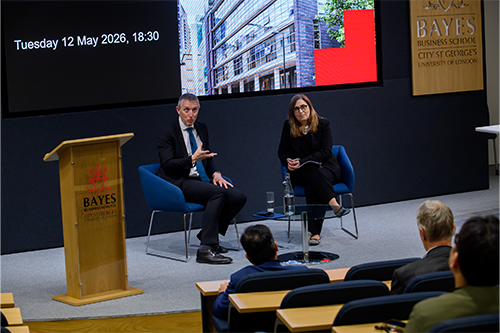
Bank of England boss explores banking supervision in lecture
Sam Woods, Deputy Governor for Prudential Regulation and Chief Executive Officer of the Prudential Regulation Authority at the Bank of England, explored the uniquely "peculiar" role of the banking sup