
Executive Dean for the School of Policy & Global Affairs recognised for his research contributions to the field of politics.
By Eve Lacroix (Senior Communications Officer), Published
Professor Charles Lees, Executive Dean of the School of Policy & Global Affairs at City St George’s, University of London, has been elected a Fellow of the Academy of Social Sciences – one of the highest honours for social scientists in the UK.
The Fellowship recognises scholars who have made a substantial contribution to social science for public benefit.
For Professor Lees, the award reflects more than three decades of research into comparative politics, party systems and democratic governance.
“It is a huge honour to be appointed a Fellow,” he says. “The Academy challenges us social scientists to not just engage with each other as academics and students, but to reach out to politicians, public servants, policymakers and citizens more broadly.”

From music to politics
His interest in politics began in Malta as a child during the 1971 general election that brought Dom Mintoff to power.
“I remember being fascinated by the campaign posters that seemed to be pasted on every inch of wall on the island,” he recalls.
Raised as part of a military family across England, Germany, Hong Kong and Malta influenced his understanding of different political systems.
“Growing up and living in different parts of the world gives a more comparative perspective and an inclination to not see events in isolation but to draw parallels from elsewhere,” he explains.
His route into academia was unconventional: a professional musician in his twenties, he went to university at 28 as the first in his family to do so.
Music and politics often intersected – he recalls the politically charged ska song “Ghost Town” by The Specials topping the charts in 1981 amid unrest in English cities.
“Going to university was a second chance for me,” he says, “and that is why I am passionate about the transformative impact – cultural as well as financial – of higher education on people’s lives and life chances.”
Research on democracy under strain
Professor Lees has built an international reputation for work on challenger parties, coalition governments and comparative political economy.
“I am interested in how democracy is under profound pressure across the world in response to what many would regard as a failing economic model,” he says. “In the West, we are seeing voters are increasingly attracted to parties that offer simple solutions to complex problems.”
His early research examined Red-Green coalitions in Germany, and he has also written on the rise of the far-right Alternative for Germany, the most significant challenge to Germany’s democratic order since 1945. His current work explores whether the political “firewall” around the party is starting to break down, particularly in the eastern states in Germany.
“This would have huge implications for Germany’s geo-political posture and European political stability,” he adds.
A newer strand of research focuses on environmental policy in China, in collaboration with colleagues at Xi'an Jiaotong-Liverpool University.
Alongside his academic publications, he has advised organisations including the Centre for American Progress, the Australian Labor Party, the Green Party of Aotearoa New Zealand and committees of the UK House of Lords.
Leading the School of Policy & Global Affairs
After holding teaching posts at the University of Sussex, the University of Sheffield and the University of Bath, Professor Lees served as a dean at Flinders University before returning to the UK in 2022 to lead the new School of Policy & Global Affairs.
“We will be four years old this August,” he says. “I came back from Australia to lead the School and – except for the odd miserable rainy morning in January – I have never regretted the decision.”
Since its launch, the School has established the Finsbury Institute thinktank, a Practitioner in Residence initiative and the Lord Mayor’s Fellowship, as well as creating the Festival of the Professions — now rolled out across the University.
“I am very proud of the initiatives we have introduced to foster knowledge exchange with stakeholders,” he says. “The leaders who have and continue to inspire me lead from the front and are values-driven. It is important that leaders can engage emotionally as well as technocratically.”
Related schools, departments and centres
Other stories you might like
-
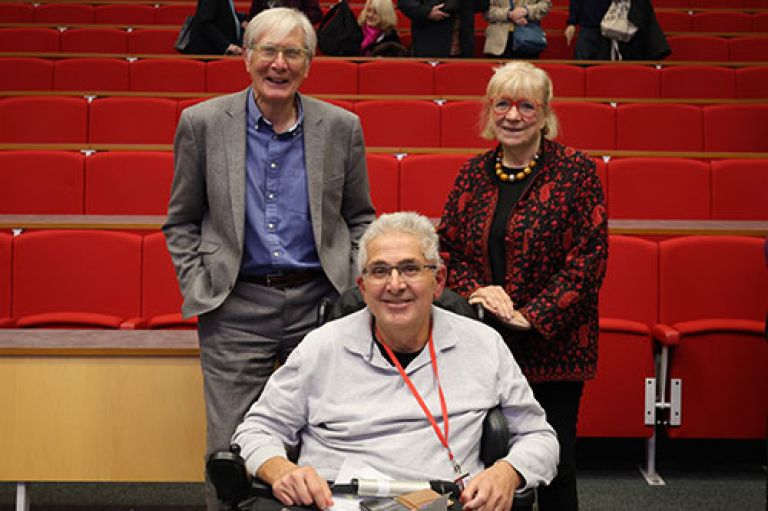
Politics as extreme theatre: How rightwing media bias and “gotcha” reporting crushed the news
Polly Toynbee and David Walker deliver the Jeremy Tunstall Memorial Lecture
-
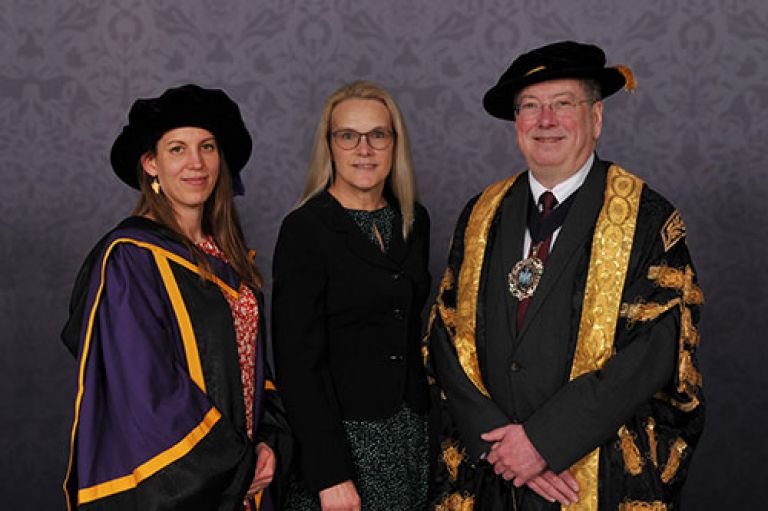
Professor Katrin Hohl appointed inaugural Lord Mayor’s Fellow
City, University of London and the Lord Mayor partner on a shared civic goal: combatting violence against women and girls in the City.
-

City St George’s appoints inaugural director of the Finsbury Institute
City St George’s, University of London has appointed Dr Diana Beech as the inaugural director of the Finsbury Institute, its new public policy institute.


