

Students from the University’s six schools graduated across six days of ceremonies
By Devangi Sharma (Communications Officer), Published
Thousands of students gathered at the Barbican Centre from Friday 10 July to Friday 17 July 2026 to attend the summer graduation ceremonies. They walked the red carpet as they collected their City St George’s, University of London degrees. The ceremonies gave graduates a chance to celebrate their achievements with their families and friends.
City St George’s President, Professor Sir Anthony Finkelstein, welcomed the class of 2026: “It has been a long, difficult and, let us be honest, expensive process. You can therefore feel a justified sense of relief. In a world that increasingly rewards certainty, speed and simplicity, I hope you will continue to value curiosity, patience and complexity. As you graduate from City St George’s, know how proud we are of you. We aim to make you ever prouder of us, not only today, but throughout your lives.”
Investment banker and philanthropist Adrian Haxby was awarded an Honorary Fellowship for his commitment to the development of the University in the last few years. Management consultant Krupali Desai was also awarded an Honorary Fellowship for her outstanding and foundational contributions to the governance and development of City St George’s, University of London.
Adrian Haxby talked about the importance of university and education:
Krupali Desai emphasised the need to put empathy at the heart of everything:

A third Honorary Fellowship was awarded to Professor Jenny Higham, the first female leader of St George’s, University of London, for her outstanding work and action that was instrumental in the creation of the University. Along with being the only woman ever to chair the Medical Schools Council, she is also the recipient of the Freedom of the City of London. This symbolic and historic award dates back to 1237, that is today a prestigious civic tribute awarded to distinguished individuals for outstanding contributions to London and its public life.
A quintet welcomed everyone as they began assembling in the hall. A processional march made its way to the stage while students hushed to contain their excitement. As graduands walked across the stage, some twirled, some jumped, some waved, while some chose to stop and take selfies. A few students were selected to address the congregation and share their experiences.
Ali Raja (Medicine MBBS), recipient of the City St George’s Academic Impact Award, ended the first graduation ceremony by addressing the gathering:

In her speech, student speaker Gisoo Akhavan-Foumani (Graduate entry LLB) reflected on staying on course amidst difficulties:

Manjyot Dhuphar (BA English Hons) talked about how human emotions will always stay relevant even in the growing world of artificial intelligence:
Ella Smart (BSc Mathematics), a student described by her tutor as ‘the kind of student that makes teachers better’, addressed the assembly:

Tamanna Nai (BSc Business with Marketing) talked about applauding your progress rather than just focusing on the next goal:
Related schools, departments and centres
Other stories you might like
-

Mother and son graduate a day apart
Tetyana Chetin, BSc Psychology with Criminology is the student speaker at her graduation. A Ukrainian mother of two children, she balanced work, motherhood and study to achieve success.
-
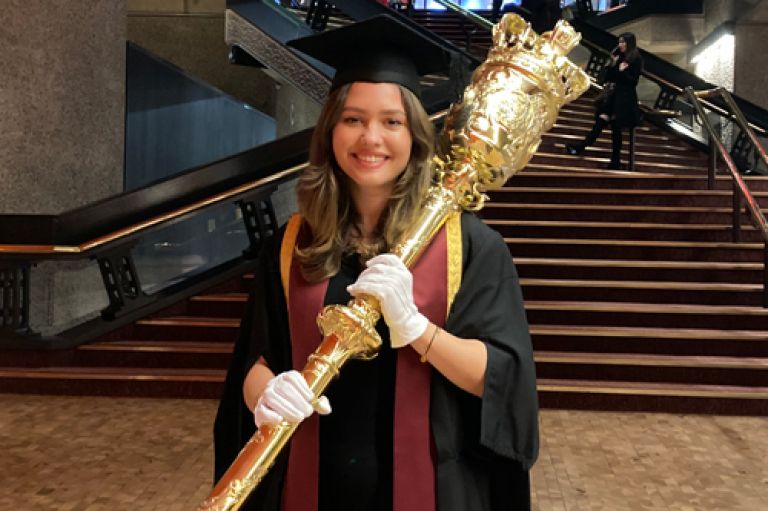
‘Knowledge is power’: Student Union President Gesmina Tsourrai addresses Bayes graduates
SU President Gesmina Tsourrai inspires Bayes students at their winter graduation ceremony and discusses her career ambitions
-
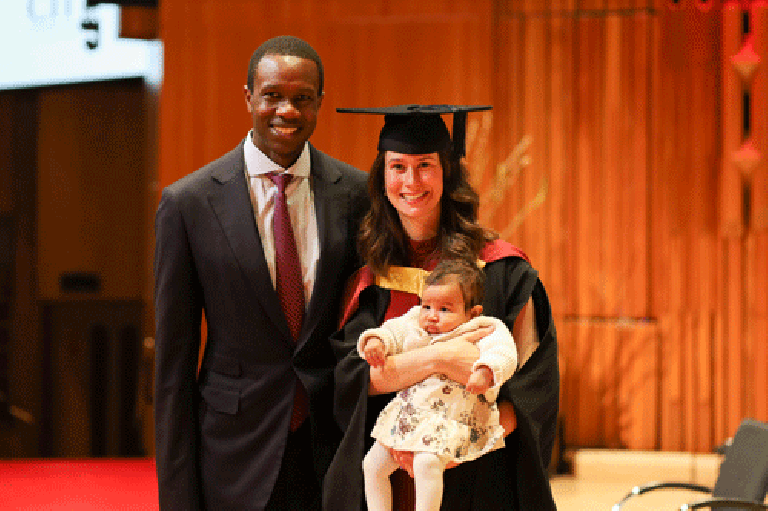
Student speaker outlines the importance of widening participation at City’s graduation
City, University of London student speaker Rachel Preston, reflects on the importance of widening participation in higher education as she graduates with first class honours.


