
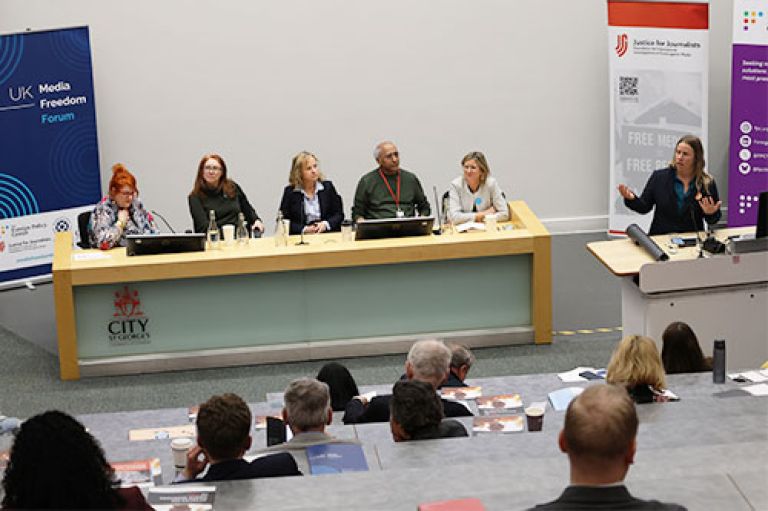
Dr Sasikumar Sundaram and Professor Inderjeet Parmar cohost parliamentary briefing with thinktank Foreign Policy Centre on divisive political rhetoric, disorder and democracy.
By Eve Lacroix (Senior Communications Officer), Published
Divisive language from politicians is putting a strain on our democracy, argued political scientist Dr Sasikumar Sundaram at a parliamentary meeting hosted at the House of Commons in June.
He was part of a panel of experts who discussed the interplay between inflammatory rhetoric from leaders from across the political spectrum, a rise in online disinformation (notably aided by algorithms and artificial intelligence) and democratic resilience.
Dr Sundaram leads the Global Disorder Group, a research network based at City St George’s, University of London, who were cohosts for the event.
Fellow event cohosts were the thinktank the Foreign Policy Centre (FPC), the All Parliamentary Political Group (APPG) on Political and Media Literacy and the social enterprise Shout Out UK.
The speakers were:
- Susan Coughtrie, FPC’s Executive Director, who chaired the event
- Dr Sasikumar Sundaram, Senior Lecturer in International Politics at City St George’s
- Professor Inderjeet Parmar, Professor of International Politics at City St George’s
- Effie Webb, reporter on The Bureau of Investigative Journalism’s (TBIJ) Big Tech team
- Amelia Fairney, SOUK’s Head of Strategy and Communications
- Matt Bishop MP, Chair of the APPG on Political and Media Literacy, who provided closing remarks.

The revolving door of British leaders and declining trust in institutions have revealed instabilities in UK politics.
Weeks ago, Keir Starmer announced his resignation as Labour leader, meaning that the next prime minister will be the fifth the UK has seen in as many years.
New parties like Reform UK have also emerged on the political scene and are adept at using social media algorithms that prioritise controversial content to their advantage, to gain attention and followers.
Reform UK’s leader Nigel Farage announced yesterday he would resign from his role as MP Clacton-on-Sea to force a by-election and stand for the role again, which some speculate is to draw attention away from a parliamentary inquiry into £5bn funding he received from a crypto billionaire and did not declare.
Farage is known to engage in media populism, using divisive language and spreading misinformation on topics like the Southport riots, the World Health Organisation’s pandemic treaty and climate change.
It is this kind of falsehoods that causes polarisation between voters.
The parliamentary panel found a concentration of economic and technological power is reshaping democratic discourse and noted that AI – which can produce false but believable videos of politicians saying things they have not at an extremely low cost – is accelerating existing vulnerabilities in the information ecosystem.
Speaking at the parliamentary event, Dr Sundaram added:
The panel agreed political and media literacy must be treated as democratic infrastructure and that strengthening democratic resilience requires systemic responses.
Professor Parmar, who is also the Associate Dean for Research for the School of Policy & Global Affairs at City St George’s, added:
The panel discussion agreed that divisive political rhetoric is a symptom of deeper structural transformations and noted that a rise in wealth inequality and a decline in quality of life was another cause for polarisation.
Dr Sundaram said:
“Rising wealth inequalities and oligarchies have displaced state entrepreneurism aimed at public wellbeing.
“Political and media literacy should therefore cultivate social purpose and critical judgment, asking not only how we communicate, but what kind of good life and accountabilities democratic societies ought to pursue.”
Professor Parmar, who is also the Associate Dean for Research for the School of Policy & Global Affairs at City St George’s, added:
“Extreme concentrations of economic and technological power have contributed to growing public distrust and of political exclusion and alienation.
“There is a widespread legitimacy crisis which fosters dangerous political movements.”
"Lasting democratic resilience will depend not only on helping citizens navigate information environments, but also on addressing the inequalities and imbalances of power that erode trust in the first place.”
The event was full with attendees spilling out the room.
"There was a real sense of engagement in the room, with participants bringing a wide range or perspectives to a timely and important discussion," said Susan Coughtrie of FPC. "Events like this show the value of collaboration between think tanks and academic networks, creating space for expertise, policy and practical experience to inform how we respond to the challenges facing democracy today."
Read the full Foreign Policy Centre briefing here.
Related schools, departments and centres
Other stories you might like
-
“A free media is a free people”: Centre for Journalism and Democracy launches at the Media Freedom Forum
City St George’s hosts urgent two-day forum to build strategies on preserving a free press internationally.
-

'There's never one reason for a riot': Dr Stephanie Alice Baker on the violent consequences of online disinformation
Dr Stephanie Alice Baker explains how online disinformation, the cost-of-living crisis and nationalism fuelled the riots following Southport tragedy.
-

Artificial Intelligence: Driving and thriving on Global Disorder?
Dr Sasikumar “Sashi” Sundaram writes for the Foreign Policy Centre, as part of a collaborative mini-series with the thinktank on the drivers of Global World Disorder.


