
The €1.2m SAPIENCE programme has been sponsored by the Science for Peace and Security Programme of the North Atlantic Treaty Organization.
By Dr Shamim Quadir (Senior Communications Officer), Published
This summer, City St George's, University of London won the third and final phase of the SAPIENCE autonomous drone programme competition at an event hosted by Delft University of Technology in the Netherlands.
The €1.2m Sense & Avoid - a cooPeratIvE droNe CompEtition (SAPIENCE) programme is a multi-year initiative funded by the Science for Peace and Security (SPS) Programme of the North Atlantic Treaty Organization (NATO).
Through a collaborative effort, the aim of SAPIENCE has been to challenge four international teams of mainly postgraduate and doctoral students to design decentralised, artificial intelligence (AI) - enabled swarms of fully autonomous drones capable of conducting search-and-rescue operations in global positioning system (GPS) - denied environments, detect and deliver aid to people in disaster areas, and perform complex cooperative tasks.
The teams included: City St George’s, University of London (UK) led by Professor Nabil Aouf; University of Alabama, Huntsville (USA) led by Dr Bryan Mesmer; Delft University of Technology (Netherlands) led by Dr Ewoud Smeur and the University of Klagenfurt (Austria) led by Professor Stefan Weiss.

In consultation with the SPS Programme, the expert academic members of the collaborating institutions devised the SAPIENCE project, with the three phases of competition being:
Indoor Search & Rescue: Held during Summer 2024 and hosted by City St George’s, University of London in London, UK
Outdoor disaster environment: Held during Summer 2025 and hosted by the University of Alabama in Huntsville, in Alabama, USA
Combined Indoor & Outdoor: Held during Summer 2026 and hosted by Delft University of Technology at the Unmanned Valley, South Holland, Netherlands
The final phase of the competition took place at the 'Unmanned Valley' — a dedicated field lab for sensor-related technologies and applications in South Holland, the Netherlands. Here, teams put their systems through a simulated disaster zone spanning indoor and outdoor settings, where their cooperative drones operated autonomously to communicate and divide tasks among themselves; sense and avoid obstacles, terrain and each another; and interpret what they found, identifying survivors and delivering different supplies depending on urgency.
In addition to thanking the other academics, teams, and NATO colleagues involved in the programme, Professor Nabil Aouf, lead on the SAPIENCE Project at City St George’s and Professor of Robotics, Autonomous Systems, and Machines at the School of Science & Technology at the University, reflected:
Related schools, departments and centres
Other stories you might like
-
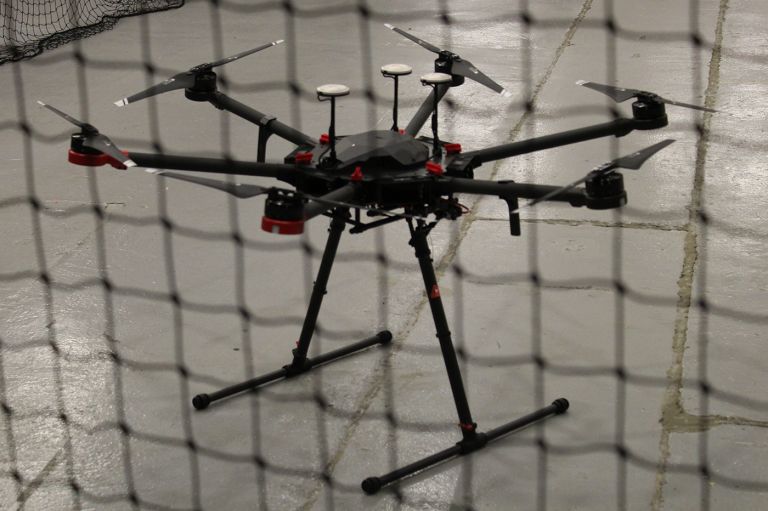
City’s Professor Nabil Aouf leads on the NATO Science for Peace and Security Programme’s SAPIENCE drone (AI based) competition project
Academics, Researchers and Postgraduate science and technology students from four countries on the €1.2m project will develop pioneering solutions for disaster relief using multi-agent drone systems.
-

NATO sponsored co-operative drone teams wow in search and rescue competition at City St George’s
Teams tested their skills in the first phase of the ‘SAPIENCE’ international drone competition, funded by the NATO Science for Peace and Security Programme.

