
The IRF provides support as well as a high standard of service to the university researchers, St George’s NHS Trust and other academic institutions in a wide range of bioimaging disciplines.
Welcome to the Imaging Resource Facility (IRF), a central biomedical resource of the School of Health and Medical Sciences. First established in 2014, the IRF provides access to Light Microscopy, Flow Cytometry and Histology methodologies and sample preparation, all housed in a single department providing a range of imaging analysis options and the expertise to compliment them. Users of the IRF have the ability to image histology samples, cells and molecules of all varieties, and model organisms such as zebrafish using any of the light microscope, slide scanning, or Flow cytometry systems we maintain, supported by experienced staff at all stages of analysis.
The Imaging Resource Facility (IRF) provides research support and services to researchers within our state-of-the-art facility. We are located in the basement of Jenner Wing, Corridor 3A, please note that facility is accessible by card access. Researcher are encouraged to reach out to our team for access and inquiries via irf@sgul.ac.uk .
Available Technologies
The IRF provides users with a wide variety of technologies and techniques for research – please use the provided resources to help plan your work; IRF staff are experts in their field and will help with project planning and experiment design; please contact irf@sgul.ac.uk at the earliest point in your project planning to discuss your imaging and sample preparation needs.
We provides free of charge hands-on training with expert scientific and technical support from our staff for optimum image acquisition and has a leading role in the academic development of biomedical and medical students by offering support and training for student research projects. All new users must first register on PPMS and complete a training/ induction session with one of our staff members to be able to utilise facility systems.
Researchers can access the facility for the following cutting-edge technologies:
- View a complete list of all systems available via the light microscopy suite.
- Access technical specifications for flow cytometry and Fluorescent Activated Cell Sorting (FACS) systems.
- The histology and Immunohistochemistry lab facilitates processing of tissue from fixation to sectioning and staining.
- A number of software analysis packages are available for image analysis in the IRF.
Facility Support and Services
Our facility is staffed by highly trained technical experts who offer comprehensive support before, during, and after equipment use. Researchers have two primary options for utilizing the facility:
- Self-Service Access: We offer free training on all equipment, enabling researchers to independently operate the technology available.
- Full-Service Support: For those requiring specialist expertise, our team is available to provide full-service assistance tailored to your project needs.
First time users should refer to Guidance documents for PPMS Users - Staff and Students to request training on their preferred instrument. Additionally, as a facility we encourage researchers to engage with us to collaborate on research projects. Our staff possess research expertise that can enhance your studies and contribute to the growth of the IRF portfolio. To explore collaboration opportunities, please contact the facility by emailing irf@sgul.ac.uk. From there, we can proceed with preliminary discussions.
Documentation, Forms, and Useful Links
The IRF provides expert support and high-quality services in various bioimaging fields to researchers at the university, St George’s NHS Trust, and other academic institutions. Find out about the useful resources and Links for users of the facility; for learning and experiment planning. You can also access all the required documentation and forms to help you get started with using the facility.
Teaching, Public Engagement, and Outreach Support
To learn how the Imaging Resource Facility can support your teaching initiatives or public engagement and outreach activities, please contact us at irf@sgul.ac.uk
Partnerships
The Imaging Research Facility (IRF) is proud of its strong and well-established partnership with Nikon Instruments UK, which has significantly enhanced teaching and research efforts at City St George’s, University of London. This collaboration has led to the successful delivery of imaging workshops, including contributions to the Frontiers in Human Health Summer School, a highly regarded program aimed at fostering new scientific insights.
Our partnerships are designed to provide the highest quality of support to City St George’s researchers and students.
Enterprise and Collaboration
The Imaging Research Facility (IRF) at City St George’s, University of London, offers advanced imaging technology and expert support for businesses and researchers. Whether you're a start-up or established institution, the IRF provides tailored solutions to accelerate your research and innovation.
Partnering with us means tapping into a wealth of expertise in advanced imaging techniques, cytometry data analysis. Our experienced team is dedicated to helping you accelerate your research, and achieve breakthrough discoveries. Let us help you transform ideas into results by emailing us at irf@sgul.ac.uk.
Meet the Team Behind the IRF
Dr Emily Woodcock – Head of Imaging Resource Facility

Dr Emily Woodcock is head of the Imaging Resource Facility (IRF) at City St George’s, University of London. The facility is a multi-disciplinary unit which offers access to world-class microscopy, flow cytometry and histology equipment, as well as training and resources for university researchers. Emily oversees the running of the facility, working in-line with the strategic and operational goals of the university.
Dr Alice Eseola – Imaging Manager

Dr Alice Eseola is the Imaging Manager specialising in light microscopy. She oversees microscope maintenance, provides training, and supports image analysis for students and staff. Alice ensures equipment is up-to-date and is always ready to assist with microscopy and image analysis issues while continually expanding her expertise.
Nikita Demchenko – Cell Biology Manager

Nikita is the Cell Biology Manager at IRF, City St George’s. His responsibilities include maintenance and management of Flow Cytometry and Histology facilities, training staff and students in the use of our flow cytometers, microtomes, cryostats, as well as other histological equipment. Nikita provides advice on experimental design and assists research groups by carrying out sample processing, embedding, sectioning, staining and scanning, as well as cell sorting.
Associates
Dr Ariel Poliandri– Director of Research Operations
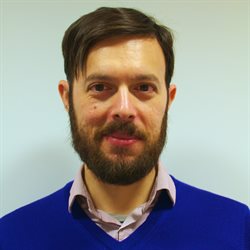
As the Director of Research Operations, Ariel heads the Research Operations Leadership Team and has oversight of the IRF’s strategic operations.
Dr Daniel Osborn – Academic Director of Image Resource Facility

I am a Senior Lecturer in functional genetics with a focus on understanding the molecular mechanisms of neuromuscular disorders using the zebrafish as an animal model of rare human genetic disease.
The zebrafish offers a tractable system for dissecting the roles of many genetics components involved in the pathology of disease. It is through my love of zebrafish development that I have become fascinated with microscopy. Zebrafish embryos develop outside of the mother and are relatively transparent, indeed we can visualise development using a simple microscope. However, cell behaviour and genetic pathway analysis can be interrogated in great detail using more powerful microscopy techniques.
With this interest in mind, I am also the Academic Director of the Imaging Resource Facility (IRF), where we aim to coordinate all the current Imaging Resources – Light -Epifluorescence and Confocal Microscopy (with live imaging capabilities), and sample preparative equipment – to offer a service to the City St George’s research community, NHS-Trust and other external users. Thus, if you feel your project could benefit of a specific microscopy technique, we would be very pleased to hear about it and see how we could help.
Imaging Advisory Group
The Advisory Group
Minutes
The Imaging Resource Facility has recently established an Advisory Group, which includes representatives from all institutes and some members of professional services with a focus on student support. The group aims to create a pan-university forum to ensure that the facility’s activities and acquisitions are aligned with the university's needs in both research and teaching. Importantly, the Advisory Group promotes a democratic, transparent, and accountable approach to resource allocation and decision-making on a broad scale.
Imaging Advisory Group minutes 23 April 2024 (PDF)
Imaging Advisory Group minutes 26 January 2024 (PDF)
Imaging Advisory Group minutes 25 September 2023 (PDF)
Imaging Advisory Group minutes 26 July 2023 (PDF)
Imaging Advisory Group minutes 27 March 2023 (PDF)
Imaging Advisory Group minutes 23 January 2023 (PDF)
Membership and Terms of Reference
IRF Research Excellence Fund
IRF Research Excellence Fund
The Imaging Advisory Group (IAG) is providing the opportunity for research staff and students to maximise potential to generate research income and/or publication success via the IRF Research Excellence Fund – an award that provides low-cost access to equipment and services in the IRF.
The fund is predominately aimed at (but not limited to) researchers who have no current funding and applications must be on the basis of one of the following criteria:
- Pilot data for grant applications
- Feasibility studies
- Publication completion
- New ideas – testing out new collaborations
Please see the IRF Research Excellence Fund application form (Word) for further details.
Successful award applicants must use the IRF Research Excellence Fund Reporting questionnaire (Word) to report the progress of the research as indicated in award letter.