

Explore past, present and future approaches to tackling some of the world’s major health challenges.
Testimonials
-
I enjoyed this experience so much. It was a wonderful opportunity to learn new aspects about healthcare and research topics. I feel like I've learned so much and by moving to a different country for a month was also really fun.
-
The summer school far exceeded my expectations, both in terms of the facilities we were able to visit and the amount of hands-on research we were able to partake in.

Frontiers in Human Health Summer School Course overview
Based in London, you can connect with fellow students, teachers and researchers as you explore global health challenges and the research approaches used to address them. Fields covered include global health, infection and immunity, genomic medicine, cancer, translational medicine and population health.
With a strong emphasis on research-informed teaching, this four-week summer school will provide you with an opportunity to gain insight into multiple aspects of the research experience by learning face-to-face and first-hand from researchers and undertaking your own short laboratory research project.
Face-to-face learning in a unique teaching hospital campus
With a strong emphasis on research, this programme is intended to provide you with opportunities to gain insight into multiple aspects of the research experience.
You will engage with specialists in the field, explore research facilities and have the opportunity to work in a group to design and complete your own short laboratory research project.
Environment
Being the UK's only university to share its campus with a major teaching hospital means you will be learning in a unique environment.
This is a fantastic opportunity for you to experience face-to-face education at one of the oldest medical schools in the country alongside one of the UK's busiest hospitals, whilst staying in one of the most socially and culturally diverse cities in the world.
Who is it for?
This intensive programme attracts international and UK students alike, allowing short-term study with real lab experience in health sciences. Ideal for students eager to study in London, gain global perspectives, and add extra credits to make their CV stand out.
Benefits
Located in the vibrant, multicultural hub of Tooting in southwest London, our campus offers the perfect balance of local charm and city life. Tooting’s friendly neighbourhood atmosphere is complemented by great restaurants, the open-air Tooting Lido, and the lively Tooting Market. Just five minutes from Tooting Broadway station on the Northern Line (Zone 3), central London is only 25 minutes away with frequent tube services.
Social programme
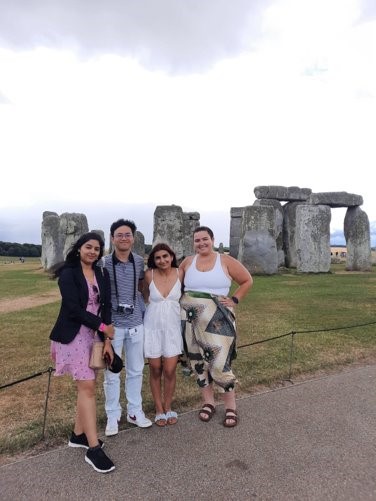 Our social programme allows students to get to know their peers and academics, in the heart of London.
The variety of events is catered to all budgets and allows students to experience various cultural experiences.
The programme is designed to allow students to have Wednesday afternoons free, as well as a free afternoon off in the third week.
Future social activities will be confirmed before the start of the summer school and may be subject to change.
If accepted onto the course the Summer School team would be happy to receive suggestions for what you would like to be included.
Examples of social activities from the 2025 summer school
- Various networking opportunities within the teaching programme – Lunch or cakes may be included!
- Trip to the Theatre – 2025 was Hercules
- Climb the O2: A climb to the top of The O2 with aerial view of London landmarks
- Visit the Wellcome Collection: A free museum and library exploring health and human experience.
- Farewell ceremony.
Previous social activities have included Tooting lido and pub lunch, a visit to Stonehenge, afternoon tea and other opportunities to explore famous landmarks.
Accommodation
For the duration of the summer school you can choose to live in Horton Halls, a 25-minute walk from the University campus. Single rooms will be provided and if necessary we can also provide female only flat shares.
If staying in Horton Halls an additional £50 refundable deposit is required. Once you have left the accommodation and upon a satisfactory inspection of your allocated flat the refund will be made as soon as possible thereafter.
What will I learn?
Our four-week summer school programme is a university Level 6 module worth 15 credits (3–4 US credits or 7.5 ECTS credits).
It offers you the opportunity to explore past, present and future approaches to tackling some of the world’s major health challenges and to design and conduct your own group research project while based here in London.
It is also possible to study as a non-credit bearing course.
You will learn to:
- identify past advancements and current research to address challenges at the frontiers of global health, infection and immunity, genomic medicine, translational medicine and population health
- appraise and discuss key concepts, research approaches and enabling technologies that underpin(ned) these advancements and apply informed speculation about how they may advance human health in the future
- apply hypothesis-driven research principles to laboratory bioscience experimentation, providing a rationale for experimental design and methodology choices
- critically analyse experimental data and present findings clearly and meaningfully for a research audience using a visual medium (poster) and associated oral presentation.
Course content
- Global health challenges
- Epidemiology and public health initiatives
- Infection and immunology
- Pandemic and Endemic infections (e.g. Covid-19, tuberculosis, malaria, HIV)
- Antimicrobial resistance
- Non-communicable diseases (e.g. cancer)
- The application of ‘big data’ in research
- Omic technologies and their application
- Personalised medicine
- Translation of research from bench to bedside and community
- The relevance of public engagement with research
- Cell and molecular laboratory experimentation
- Experimental design, data analysis and presentation
- Visits to City St George’s facilities including research labs, dissection room,
- pathology museum, archive and image resource facilities
- Career development advice
- Identifying transferable skills
- Progressing your research career.
Mini-research projects
A major feature of the summer school is the opportunity to carry out a mini-research project based in the University’s biomedical research laboratories, supervised by active researchers.
Based around a current research question, you will work in groups to design and execute your own research project within a scenario provided, analysing the data and presenting your findings as a scientific poster suitable for a research conference. No previous experience is necessary.
The project will include a thorough grounding in the laboratory techniques involved and a series of experimental design and data analysis workshops will take you step by step through the process from start to finish, with ample opportunities to practice and receive feedback.
Approximately one third of the summer school will be devoted to the research project, with the laboratory sessions focused largely in the third and fourth weeks.
At-a-glance indicative timetable
Over the first 2.5 weeks, taught sessions will be scheduled in the mornings from 10am, with interactive group sessions, visits and activities in the afternoons, usually finishing at 4pm.
Evenings are kept free for social activities, however if there are any scheduled Research Insights talks these will take place after 4pm.
Course delivery
A typical day starts with seminars/lectures (35 hours total) and interactive sessions (25 hours) in the morning (typically in 45 minute blocks with regular breaks between), usually breaking for lunch at 1:30pm. The afternoon’s interactive workshops (including facilities visits and sessions focused on careers) typically run between 2:30 and 4pm.
This phase finishes with a two hour seen examination in the middle of the third week, preceded by revision and consolidation workshops.
The laboratory mini-research project (30 hours) is the focus of the second half of the third and the fourth week, ending with a conference-style poster presentation session of your research findings with an expert panel.
The research project days will be from 10am to 4pm (with regular breaks) but might occasionally be longer. They will be evenly balanced between hands-on laboratory work and interactive workshops for design and analysis.
The rest of the course is made up of:
- Self-directed study and analysis (30 hours)
- Preparation for examination, and preparation of research project presentation (30 hours)
- Total: 150 hours.
Final details of academic sessions and social activities will be confirmed before the start of the summer school and may be subject to change.
Assessment and certificates
Assessment
For award of academic credit, achievement of module outcomes will be assessed by 2 summative assessments:
- A 2 hour written examination
- A visual poster with an accompanying short oral presentation.
An aggregate mark of 40% across the 2 assessments will result in award of 15 academic credits.
Successful students will recieve a transcript for Level 6, 15 academic credits.
Written examination
You will undertake an invigilated 2 hour online examination in which you will answer a single question that will have been presented to you during the first week of the summer school (a seen examination).
The question, which will be formulated around the theme of Frontiers in Human Health, will require you to write an article for informed non-specialists (e.g. Scientific American), drawing on insights gained during the course, complemented by your own critical analysis, reflections and speculations.
Poster and oral presentation
Together with your group research project peers, you will design and produce a scientific poster describing the background, rationale, methods, and findings of your mini-research project, critically analysing the results and discussing their limitations, wider implications, and next steps.
You will give a group oral presentation on your poster to peers and an expert panel of assessors.
The oral presentation will be a maximum of 7 minutes followed by 3 minutes for questions and answers.
Assessment weighting
- Seen exam - 60%
- Research project report - 40%
- Written poster - 20%
- Postal oral presentation - 20%
Credits
This course is worth 15 credits toward eligible programmes.
How to apply
The team at summer@sgul.ac.uk will be responsible for the full admission and finance process for this programme and will be happy to answer any queries.
Applications are now closed, application for summer 2027 is due to open in January.
Eligibility
The summer school programme is open to current undergraduate students and recent graduates with a background in health or biology-related fields.
Applicants should have a basic understanding of biology or biosciences (equivalent to A-levels* or higher). As the course is taught at Level 6, prior knowledge of fundamental biology is essential to fully engage with and comprehend the material. Applicants from other disciplines are welcome to apply as non-credit participants, and their applications will be considered on a case-by-case basis.
*or an equivalent qualification, such as the Diploma of Secondary Education, International/European Baccalaureate, Irish Leaving Certificate, or Standard XII.
International students
If you are travelling from abroad, please check UK government guidance and the advice of your own government before making any arrangements to travel.
More information about entering the UK can be found on the GOV.UK website.
Visa information
If you have any visa or immigration related questions, please do not hesitate to contact the International Advising Team.
If you reside outside the UK, you may need a standard visitor visa to enter the UK and take part in the summer school.
Please note that it is the responsibility of each student to secure an appropriate visa, travel to the UK and meet any entry requirements prior to the start of the summer school.
City St George’s, University of London is unable to reimburse students for any expenses incurred if they are unable to arrive on time for the start of the summer school.
English requirements
Students who have not previously completed a degree program taught in English must have an overall IELTS score of at least 6.5, with a minimum score of 6.5 in writing. Students without the required IELTS score may still attend the summer school; however, they will not be awarded module credits.