

By Chris Mahony (Senior Communications Officer), Published
An adventurous academic has “reimagined” torturous policy debates over the Euro and bank bailouts as comic thrillers replete with Chancellors-gone-rogue, murdered central bank economists – and a honey trap.
Andrew Clare, Professor of Asset Management at Bayes Business School and a former Bank of England employee, has just published Und£rh€dged, the sequel to his 2023 debut, The Old Lady.
It again features Bank of England senior economist Sebastian Oates, who in the first novel, set in 2003, tangled with ‘dark Europhile forces’ intent on forcing the UK into the Eurozone by trashing the county’s economy.
The sequel is also set in the past; with Sebastian seconded to a dodgy hedge fund as the Global Financial Crisis first looms into view and then explodes. Never mind Lehman Brothers’ collapse imperilling the very survival of the global financial system: it is even grimmer for Sebastian by unleashing a series of murderous events which climax in a mass shootout.
Despite the murder and mayhem, Professor Clare says that the books offer a more realistic portrayal of City workers than TV or cinema usually manages.
“None of the City-related dramas I've watched feel like the writers have ever worked in the Square Mile. Many people who’ve read The Old Lady realized there was authenticity in it because I was writing about the City environments and work practices I had enjoyed – and occasionally endured.
“It is a strangely underexplored industry given both its history and enduring importance to the UK economy and our everyday lives. When someone does turn a light on it artistically, too often we see a caricature. The old stereotype of bowler hats and brollies no longer endures, but contemporary depictions of the City still wheel out an array of cartoon spivs, wideboys and braying multi-millionaires. In reality, the vast majority of workers in the City are very ordinary people. I also try to bring out just how sociable the City is.”
The spy who Libored me
His affection for the venerable institution he once worked for, and for those who work there, comes through strongly.
The first novel is dedicated to “the Old Lady’s army of hard-working economists, past and present”.
Professor Clare says: “I do admire the people who work at the Bank of England. They're not earning the millions that most could in investment banks. Instead, they want to serve the public because, while most people don’t know it, getting monetary policy right creates the stable environment that allows us all to go about our lives.”
His preference for situating his novels in the recent past is not, he says, driven by any wish for plausible deniability.
Threading the needle
“I wrote three chapters of The Old Lady in 2003 and then got distracted by life. I I found them again when clearing things out during the pandemic. Re-reading those early chapters I thought it was worth pressing on – and the book appeared in 2023.
“I didn't want to bring the second story completely up to date at this point, because we’ve lived through momentous times since the 2008 global financial crisis when this story is set. You can trace a lot of the things we're living through today back to those days. That’s certainly true of the problems that the government is having with debt and the rise of populism. It was then that ordinary people started questioning elites, because the crisis proved they didn't know everything after all.”
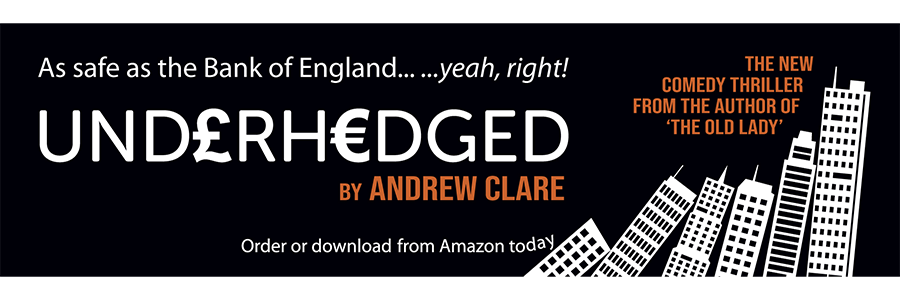
Above: The cover of the sequel.
Professor Clare is nearing the end of a sabbatical from Bayes - where he teaches asset management on the MSc Finance programme which the Financial Times recently ranked top globally for alumni career progression and salary increase.
The settings for his fiction draw on a three year stint in Threadneedle St as senior research manager on a monetary analysis team established to support the Bank of England’s monetary policy committee. He joined in 1998, the year after the new Labour government had made the bank independent. Earlier he had worked as a financial economist at Legal & General Investment Management.
More recently, he has reinforced his teaching and research at Bayes with service as a trustee on several large pension schemes – and written a guide for pension fund trustees which is perhaps a more practical, if less pacy, read than his novels.
His strong links in the City mean he is upbeat about the Square Mile’s future.
“Much has changed in the UK economy since the 2008 Global Financial Crisis with Brexit and then Covid, but what is remarkable is that City life has not changed that much at all. As long as international finance exists, London's expertise is going to be central to that. The services provided in the City of London and surrounding areas are still very highly specialized and still very highly valued by organizations, both corporate and government, all around the world.”
Their confidence in the Square Mile, we hope, will survive a second fictional helping of the unacceptable face of British capitalism.
- Both novels are available from Amazon.
The Old Lady: A thriller set in the heart of the Bank of England