

In this tribute we honour Dr Aggrey Burke, a psychiatrist and academic whose contributions left a lasting legacy on City St George’s.
Published
Dr Burke spent much of his medical career at legacy St George’s, University of London, and later City St George’s, University of London, and was a leading campaigner against discrimination in healthcare throughout his career.
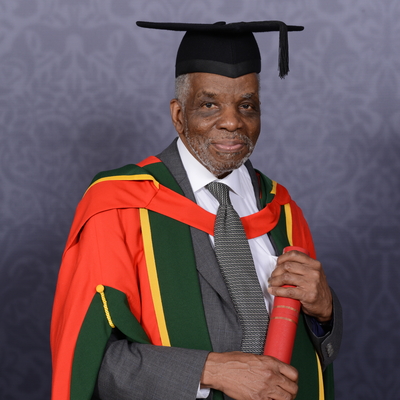 Dr Burke was born in 1943 in Saint Elizabeth, Jamaica, before moving with most members of his immediate family to Kew in 1959. His father, Eddie Burke, was the Secretary Manager at Jamaica Welfare Ltd when he was seconded to work in the UK in the Migrant Services Division of the West Indies Commission. A key part of Eddie’s secondment as the Community Development Advisor was working to reduce tension between members of the local population and migrant West Indians following racial unrest.
After graduation he began his psychiatric training in Trinidad and Tobago. He completed his training as a research fellow in the Department of Psychiatry at Birmingham University.
Alongside his studies, he volunteered with the grassroots self-help group Harambee Organisation, which organised a Black supplementary school to combat the neglect and abuse that Black children faced in the education system.
Dr Burke later went on to teach at the University of the West Indies – returning to the UK in 1972 to take up a research fellowship at the University of Birmingham. In 1977 he was appointed Senior Lecturer in Psychiatry at St George’s and consultant psychiatrist in the NHS. He was the first black British person to be appointed in this capacity.
Aggrey dedicated much of his early career to conducting studies on the mental health of repatriates at Bellevue Hospital, Jamaica, concluding that repatriation caused significant psychological harm. His work also demonstrated how deprivation is associated with mental illness in some black communities.
Following his return to the UK, he carried out psychotherapeutic work with bereaved families following the New Cross Fire, helping set up a group to attend to the emotional needs of the survivors and the families.
Dr Burke was highly regarded for his extensive research on racism and mental illness. Throughout his career and into retirement, he fought tirelessly against discrimination in healthcare and for the rights of marginalised people, sacrificing his own advancement to do so.
In 1986, along with his colleague Professor Joe Collier, he published a paper that showed clear evidence of racial and sexual discrimination in the selection of students for London medical schools. Later, after finding evidence of discrimination against Black and female students in admissions policies and interview processes at legacy St George’s, Professor Collier and Dr Burke reported this to the Commission for Racial Equality, prompting an enquiry leading to changes in admissions processes.
Speaking about the paper, Professor Collier said:
“In both his professional and personal life, Aggrey worked tirelessly against racism and the damaging effects of discrimination. When Aggrey and wrote to the Commission, he warned me that, as a white colleague exposing this discrimination, I would be attacked by the establishment, and I will never forget how he supported me through all the aggression I faced - I miss him deeply."
In 2022, Dr Burke received an honorary award from legacy St George’s, University of London (now the School of Health & Medical Sciences) in recognition of his achievements and contributions.