
New research consortium, led by Professor Dan Mercea at City St George’s, University of London, to research the state of democracy.
By Eve Lacroix (Senior Communications Officer), Published (Updated )
Trust in the establishment – government, media, science, healthcare – is declining. How then, has political participation changed since the Covid-19 pandemic?
City St George’s, University of London is coordinating a new project with the research consortium INTERFACED to interrogate this question and provide practical policy recommendations to stakeholders in the European Union, in the UK, and in Tunisia.
The consortium was granted €3 million by Horizon Europe, which is the European Union’s key funding programme for research and innovation, to carry out the project between January 2025 and December 2027.
In a time marked by declining trust, growing social divisions, and widening inequalities, INTERFACED seeks to explore how political participation has evolved.
It will assess how effectively a plurality of political interactions enables genuine citizen involvement in decision-making and governance.
The project is led by Professor Dan Mercea, expert in digital and social change at City St George’s. He said:
Enhancing democracy through policy recommendations
A multinational study involving eight European countries and Tunisia will be conducted, capturing a variety of political contexts, including environments where citizens actively oppose authoritarianism.
The project will employ a diverse array of research methods —ranging from large-scale surveys and experiments to computational data analysis and ethnographic fieldwork—to create a comprehensive understanding of political participation in these countries.
By studying how citizens and governments interact, INTERFACED aims to bridge the gap between citizens and decision-makers by identifying ways to enhance democratic systems.
The project will prioritise understanding and addressing the barriers that prevent marginalised and disengaged groups from participating in governance.
INTERFACED seeks to create more inclusive political systems that reduce inequalities, empower individuals, and ensure that democracy serves everyone by providing practical policy recommendations.
The INTERFACED consortium
The consortium name stands for Interfaces for Democratic Participation: Deliberation, Mobilisation, and Contestation Since the Onset of the Covid-19 Pandemic.
It brings together 11 partners from 10 countries, drawing on expertise from academia, civil society, and the private sector. This diverse collaboration ensures a robust and innovative approach to research, practice, and policymaking:
- City St George’s, University of London (United Kingdom)
- Dublin City University (Ireland)
- Edgeryders OU (Estonia)
- European Citizen Action Service (Belgium)
- HUN-REN Társadalomtudományi (Hungary)
- JFRC Fondation Jasmin Ltd. (United Kingdom)
- Johann Wolfgang Goethe-Universitaet Frankfurt am main (Germany)
- Københavns Universitet (Denmark)
- Universidad Carlos III de Madrid (Madrid)
- Università degli Studi di Parma (Italy)
- Universitatea Babeș-Bolyai (Romania).
Related schools, departments and centres
Other stories you might like
-

How is the European Green Deal faring? European Social Survey will evaluate the shoots
The European Social Survey (ESS) receives European Commission funding to evaluate how the European Green Deal impacts Europeans of all ages.
-

New pilot study enhances understanding of situational fear
Policy paper from City, University of London reveals lived experiences of students and methodology for measuring triggers of fear.
-
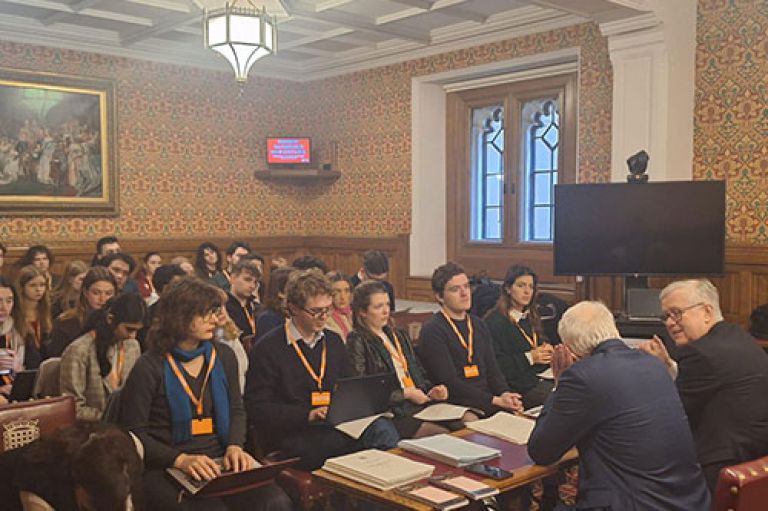
Political Headlines: how a story grows from a whisper to front-page news
MA Newspaper Journalism students take part in Political Headlines module, hearing from top Lobby journalists on campus and politicians at Westminster.


