
Professor Danielle George, Chief Scientific Adviser for National Security, delivers the School of Science & Technology’s Athena SWAN lecture 2025.
By Dr Shamim Quadir (Senior Communications Officer), Published
On Tuesday 4 November, colleagues at the School of Science & Technology, City St George’s, University of London were delighted to welcome Professor Danielle George CBE FIET, to deliver the School’s Athena SWAN Lecture 2025.
The School uses the Athena SWAN charter as a framework to progress gender equality for all.
Professor George is the UK Government’s Chief Scientific Adviser for National Security, and is Professor of Radio Frequency Engineering at the University of Manchester.
Her lecture spanned what she (or what originally she said her husband) described as her ‘3Ps and a CSA’ referring to a period of her life spanning becoming a professor (the first ‘P’), at the same time as becoming pregnant (the second ‘P’) and her ‘presenting’ the 2014 Royal Institution Christmas Lectures (the third ‘P’). ‘CSA’ stands for becoming ‘Chief Scientific Adviser’.
She was introduced by Professor Juliet John, Vice President (Education), City St George’s, University of London.
Loving astrophysics
Professor George began her lecture by remarking on it being a keen interest rather than lofty ability that set her off on her career:
She further set the scene by describing what was and still is the first love of her career, radio astrology, describing the Jodrell Bank Observatory in Cheshire where she started as a junior engineer.
Professor George took her audience on a tour of how the observatory’s radio telescope works and where the amplification of the radio signal from space comes in. She showed the amplifier in the form of a microchip, which is precisely the technology her team works on.
She shared projects she worked on in her career, including the Planck mission which has sent out a probe to “Lagrange Point 2”, an area of space relatively devoid of radiation in order to get clear images of the wider ‘cosmic background radiation’, which is a snapshot of our universe in its very early stages and can teach us important lessons of how it was formed.
Translational engineering
Professor George shared how she has managed to apply her speciality in developing sensing technologies from her radio astronomy career into technologies that can be applied in other industries, such as in the aviation and agricultural industries, with this cross-cutting work being crucial to her receiving tenure and becoming a professor.
Her professorship, in turn, opened many more doors for her career, including being asked to deliver the Royal Institution Christmas Lectures 2014. However, this included a welcome catch – she found out that she was pregnant and had doubts that she would be able to deliver the lectures at the same time. But she eventually resolved to and did, eight and a half months into her pregnancy. She also had to pitch her ideas for the lectures to the Royal Institution:
Professor George discussed two further cutting-edge projects she worked on, including the Square Kilometre Array across Western Australia and South Africa, which is still in development, and which will be the world's largest radio telescope, with a collecting area of one million square metres of low radio frequency receivers.
She also discussed the ALMA project consisting of 66 radio telescopes in the Atacama Desert, Chile, which explores space in the very high radio frequency range.
Table salt from black holes?
Professor George shared a video taken from an image from ALMA, showing the ‘clock constellation’, and a spiral galaxy called NGC1433 –with a massive black hole in the middle of it. Astronomers found that black holes like this spew out sodium chloride, commonly known as ‘table salt’. She said that while we do not know why salt is emanating from these blackholes, it poses an intriguing question for scientists and engineers for the future.
A passion to inspire the next generation
Professor George is committed to inspiring the next generation to ask and answer the biggest questions about space. She remarked on a talk she gave for children:
Not only do children have natural curiosity, a key ingredient for scientific endeavour, they also have a great opportunity to shape the future of discovery. She ended her lecture with an inspirational quote from a school girl: ‘I’m you in the future, so if you help me now, I can be better than you’. And this is surely the great work of every passionate scientist, to push the boundaries of the unknown and encourage the next generation to go even further.
Professor George’s lecture was followed by a very lively Q&A including questions on improving gender equality in industry and academia, and her role as Chief Scientific Adviser for National Security, such as how national security interacts with industry and academia.
Kenneth Grattan, George Daniels Professor of Scientific Instrumentation at the School, concluded the event with words of thanks to Professor George on behalf of City St George's University of London.
Athena Swan Charter
The School uses the Athena Swan charter as a framework to progress gender equality for all. You can find out more on its dedicated webpage.
Other stories you might like
-
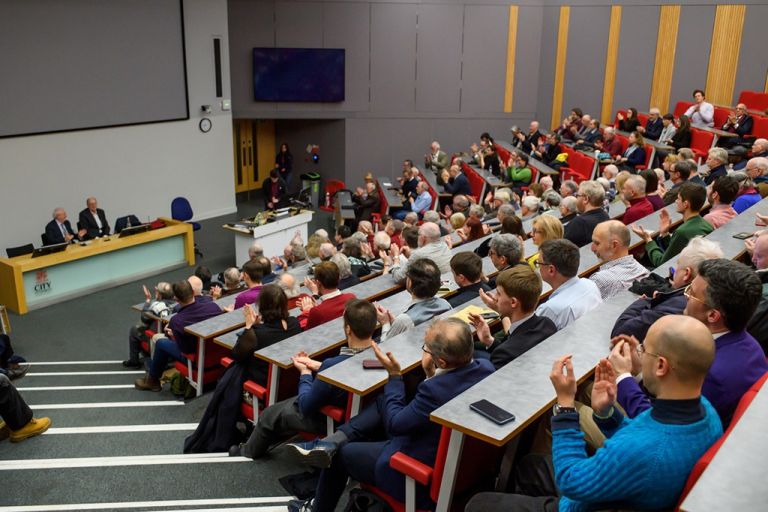
George Daniels Lecture: the Antikythera mechanism - nearly impossible?
Professor Tony Freeth on the history of our understanding of a seemingly improbable device that measures the ingenuity of the astronomers of ancient Greece.
-
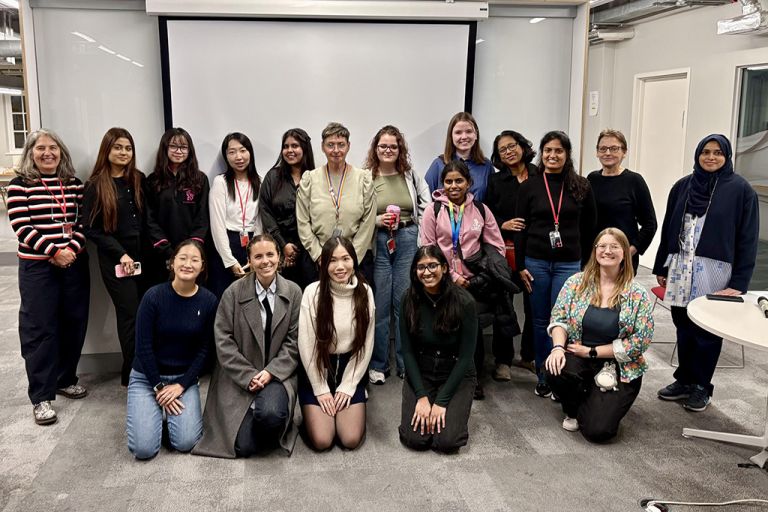
Celebrating Ada Lovelace Day at City St George’s
Students, alumni and staff at the Department of Computer Science gathered for a series of talks to celebrate the achievements of women in STEM.
-
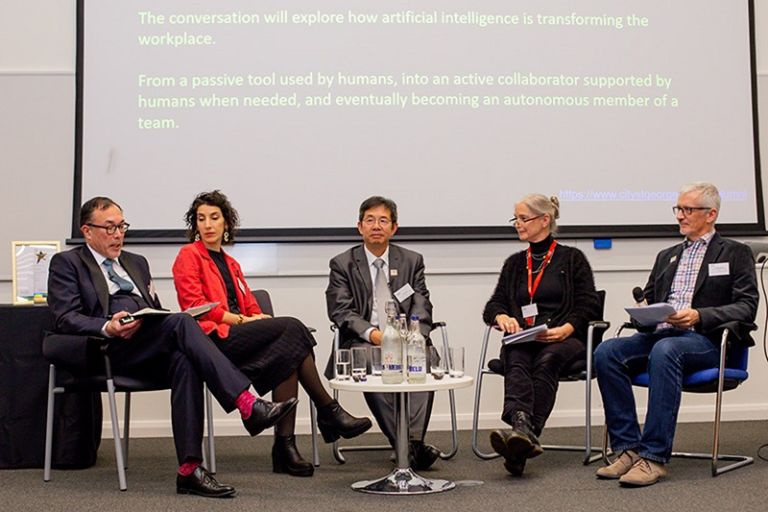
Celebrating the fourth STEM Alumni Awards at City St George’s
Awardees engaged the ceremony attendees with the panel discussion: ‘The Human-AI Workplace of the Future: The Path to Coexistence’.


