
In summary
Dr Diana Yeh’s research shows how racism against East and Southeast Asian communities in Britain operates not only through overt acts of violence but also through state and institutional practices and cultural marginalisation.
She argues that structural inequalities, such as immigration restrictions, are as harmful as physical assaults. Her work highlights how the recent Stop Asian Hate movement can be understood as part of a new wave of resistance, uniting different Asian communities in collective activism.
What did we explore and how?
Dr Yeh is a leading sociologist at City St George’s, University of London. Her cultural research has helped preserve the legacy of British Chinese artists such as Chiang Yee, Hsiung Shih-I, and Dymia Hsiung. By archiving their achievements, she ensures that their work is not erased from British cultural history.
She has also researched the barriers faced by British East and Southeast Asian creatives in the film industry, work which inspired filmmaker Rosa Fong to produce a series of short films. Yeh’s expertise has been recognised by major cultural institutions including Tate Britain and the National Portrait Gallery, where her work has been featured.
She has also investigated the everyday cultural politics of belonging among young British Asians. As Principal Investigator on a British Academy and Leverhulme Trust-funded project, she studied race and participation in night-time cultures, revealing how leisure spaces can reproduce or challenge racial hierarchies.
Her most recent work examines pan-Asian activism in response to the surge of anti-Asian violence during the COVID-19 pandemic. Dr Yeh analysed how communities organised under the banner of Stop Asian Hate.
She has argued in media interviews with outlets such as Channel 5 News, Hong Kong Radio and Television, and Arirang News (South Korea) that focusing only on violent incidents obscures deeper systemic issues.
For example, she notes that hostile immigration policies restrict access to healthcare and services, creating harms as profound as physical attacks. In a BBC Radio 4 interview, she also discussed how fetishisation in Western art perpetuates racialised stereotypes, demonstrating that cultural racism and institutional discrimination are intertwined.
Benefits and influence of this research
Dr Yeh’s work reframes understandings of racism against East and Southeast Asian communities by linking everyday prejudice, institutional discrimination, state racism and violent assaults.
By documenting the historical contributions of Asian artists, she expands Britain’s cultural archives, challenging the invisibility of these communities. Her research into structural barriers in the creative industries supports calls for policy change, while her work on British Asian contributions to the arts shows how racism can shape — and sometimes limit — creative spaces.
Dr Yeh’s work shows how activism against immediate violence connects with longer struggles against exclusion in culture, politics, and public life. Her research equips campaigners, policymakers, and cultural institutions to better understand and address the multiple forms of racism faced by Asian communities.
By insisting that state and institutional racism is as damaging as, and interconnected with, everyday physical violence on the streets, Yeh broadens the conversation on race and justice in Britain today.
What's happening
-
Event
Nov 04
Postgraduate Open Evening (Clerkenwell Campus)
Join us at our Postgraduate Open Evening to learn more about our postgraduate courses and discover all the benefits of studying at City St George's, University of London.
, 16:45 – 19:00
Location: Clerkenwell campus
Audience: Prospective students
-
News

Penguin Random House’s Rebecca Sinclair appointed Honorary Professor at City St George’s, University of London
Senior publishing executive to join City St George’s to further strengthen publishing industry ties with a focus on reading for pleasure, freedom of expression and audience engagement.
-
News
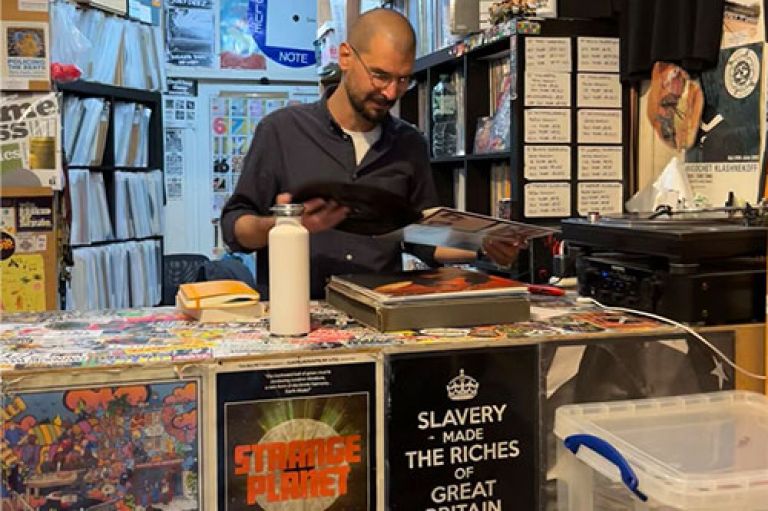
Policing the Beats
Cultural criminologist and vinyl-head Dr Lambros Fatsis launches book Policing the Beats which exposes the racist policing of Black music.

