

A new collaborative project, funded by the Office of the Police Chief Scientific Adviser, will use advanced data science techniques, police data, and insights from young people with lived experience, to identify and prevent abuse in teenage relationships.
By Eve Lacroix (Senior Communications Officer), Published
Teenagers experience disproportionately high and increasing rates of abuse in their intimate relationships.
Frontline workers, like police officers, teachers or social workers, lack evidence on how to best identify abuse in teenage relationships and how to stop it from occurring.
Criminologists and data scientists from City St George’s, University of London and police at the Gloucestershire Constabulary have been awarded funding from the Office of the Police Chief Scientific Adviser (OPCSA) through the Police STAR Fund, to close this gap.
Dr Ruth Weir (Deputy Director of the Violence & Society Centre at City St George’s) and Deputy Chief Constable Katy Barrow-Grint (of the Gloucestershire Constabulary, and Honorary Research Fellow at City St George’s), will co-lead the project, and have partnered with the domestic abuse charity SafeLives.
Uncovering the risks, harms and scale of teenage relationship abuse
The research project will establish what the risk and harms of abuse in teenage relationships look like and how they differ from adult relationships.
To establish the scale of the problem, the project will analyse police data to identify incidents involving under-16s over the past ten years that have remained hidden in police records.
Teenage relationship abuses cases have been hard to identify previously, due to under 16s not being flagged as experiencing domestic abuse under current law.
The project will also provide guidance on identifying and responding to teenage relationship abuse for people working across the police, in social care, in education, in youth services, at health services and across specialist support services.
Young people with lived experience of abuse, and people working with young people, are involved at every stage of the research.
The project is designed so that the guidance can be rolled out across police forces nationally.
Human-led technological solutions: Combining AI with lived experience
The project will use cutting-edge research methods, including Natural Language Processing (NLP), which is an artificial intelligence (AI) technique that analyses large volumes of text.
The research combines NLP, analysis of ten years’ worth of anonymised police and other data from Gloucestershire Constabulary, and interviews and focus groups with young people with lived experience.
The NLP will be informed by insights from SafeLives Changemakers, who are a group of young people aged 13-24 that are experts in the challenges their peers face today. Some also have lived experience of domestic abuse.
With their understanding of how young people talk about teenage relationship abuse, the Changemakers will sharpen the NLP model's ability to recognise cases of teenage relationship abuse “hidden” inside a decade of police records.
Dr Ruth Weir, said:
DCC Barrow-Grint said:
About the project
Also on the research team are Dr Darren Cook, Research Fellow in Natural Language Processing at City St George’s; Dr Annie Bunce, Research Fellow in Criminology at City St George’s; and Dr Katerina Hadjimatheou, Director of the Centre for Criminology at the University of Essex.
The funding comes as part of the Police STAR Fund, which is an annual innovation call run by the OPCSA to stimulate local innovation, encourage collaboration and solve scientific and technological problems within policing.
City St George’s works with industry to develop academic research which responds to real-world policy needs.
This project directly supports the Government’s Violence Against Women and Girls (VAWG) Strategy by strengthening prevention and early identification of abuse, improving systems understanding, and informing proportionate, evidence-led responses for young people.
Colleagues from the National Centre for VAWG and Public Protection (NCVPP) and the National Police Chiefs’ Council (NPCC) sit on the advisory board of the project.
Related schools, departments and centres
Other stories you might like
-

In memory of Holly Newton: Why teens fall between the gaps of domestic abuse support
Academics from the Violence & Society research centre echo Holly Newton’s parents call for domestic abuse policy reform to better protect teens.
-
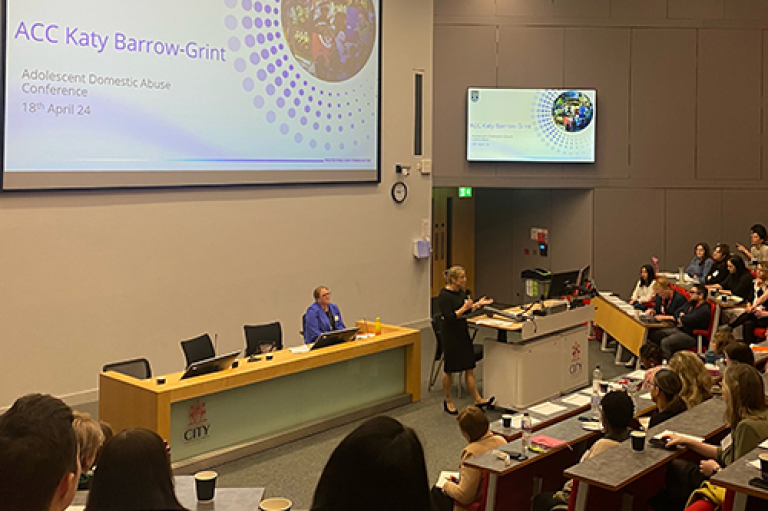
‘We’ve got to do more so that children don’t fall through the cracks’: City hosts conference on adolescent domestic abuse
The VISION Adolescent Domestic Abuse conference highlighted key issues in supporting adolescents around this specific type of abuse which is often overlooked.
-

Sexual violence costs England and Wales £400 billion
The UKPRP VISION conference discusses how to mobilise a cross-government response to violence prevention, and launches a calculator and animation to support understanding of violence-related research.


