
By Chris Mahony (Senior Communications Officer), Published
Chancellor Rachel Reeves admitted that the context for her second Mais Lecture at Bayes Business School today was not the one she would have chosen.
She said: “(The turmoil in the Middle East) affirms, rather than challenges, the philosophy I outlined in opposition, and which has guided me in government.
“In a more volatile world, there are always excuses to put off the hard work of reform but we must focus on the causes, as well as the symptoms, of our vulnerabilities.
“So this is a moment not to prevaricate, not to retreat to comforting old orthodoxies, but to press ahead to build secure, resilient growth, guided by an active and strategic state.”
Referring to her first Mais Lecture on growth in an ‘age of insecurity”, she said the multiple crises since 2008 had affirmed that “globalisation, as we once knew it, is dead”.
She continued; “Each crisis has reminded us that ours continues to be an interconnected world in which a country’s competitiveness, openness to trade, and credibility on international financial markets remain critical. However, that easy optimism about global economic integration has faded with shocks in one part of the world transmitted swiftly along fragile global supply chains impacting prices and living standards here at home.
“My conclusion was that we must build growth that is secure and resilient. Growth is the condition for secure and rising incomes, the revenues to support our public services and a strong state able to safeguard our people. But without security, growth is little more than a thought experiment, an abstraction which dissolves upon contact with the real world.
“That insight underpins the strategy that I called ‘securinomics’.”
She outlined her “three big choices, the areas in which I have identified the greatest growth and investment opportunities for the UK in the decade to come and the action we are taking to grasp them”.
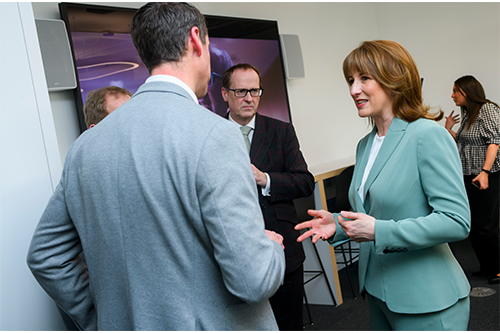
Above: The Chancellor spoke with industry leaders after the Mais Lecture.
She continued: “Securinomics” is built on one crucial idea: “An active and strategic state, working with business to build secure and resilient growth, stepping up its role in expanding the supply side of the economy, making conscious and deliberate choices about the sectors we pursue leadership in and the capabilities we must protect or grow. (It is) an approach embodied in our modern industrial strategy.
“The active and strategic state is guided by three priorities: stability, investment and reform.
“We can leave it to the market alone, and let the balance of risk and reward be determined by a super-wealthy few. Or we can chart our own path where an active and strategic state protects British interests through AI sovereignty with absolute clarity about where growth will come from and (about) who will benefit, - harnessing and shaping new technology in our common interest.
“I want to be absolutely clear about what our strategy is. First, to build sufficient compute to protect our interests and avoid excessive dependencies on others. Second, to establish our foothold and compete fiercely in the areas where we have real strengths such as AI applications, AI chip designs and cyber security.
“Third, to maximise the value added by AI to the wider economy and the public sector through accelerated adoption.
“And fourth, and most importantly, to equip working people with the tools they need to maximise the rewards and minimise the risks.”
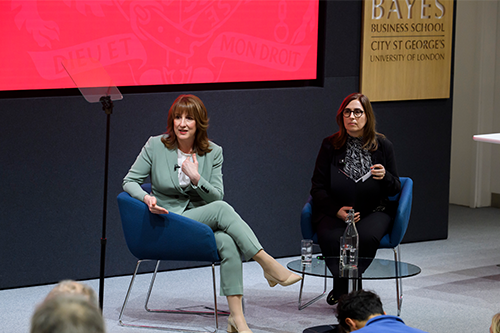
Above: Ms Reeves (left) takes a question from a journalist as Professor Barbara Casu, Deputy Dean and Chair of the Bayes Centre for Banking Research, looks on
Welcoming Ms Reeves, Bayes Executive Dean Professor Andre Spicer said:
“This September will mark the beginning of our school’s 60th anniversary. Perhaps our greatest achievement is the people we have educated who have gone on to transform industries. These include Stelios Haji-Ioannou, who founded easyJet, former Coca Cola global CEO Muhtar Kent, the serial tech entrepreneur and chair of the King's Trust - Tom Ilube, and Neville and Maya Tata who are the next generation leaders in the Tata group.
"The Mais Lecture has been a key event in our calendar for nearly fifty years. This annual lecture was established in 1978 to honour Lord Mais, a former Lord Mayor of the City of London and Chancellor of this University, City St George’s, University of London. Lord Mais helped establish the Centre of Excellence for Banking and Finance here at Bayes – and it is that centre which organises this event.
"Since 1978, we have welcomed a long list of acclaimed speakers including Governors of the Bank of England, current and future Chancellors and Prime Ministers, a Nobel Prize Winner, and Heads of the International Monetary Fund, the Federal Reserve and the Bundesbank. Not to mention a former Chief Rabbi, a French President, and Professor Fredrick Hayek – regarded as the intellectual father of Thatcherism and Reagan-nomics.
“Our speaker today, the Chancellor Rachel Reeves, is the first from that venerable rollcall to deliver a second Mais Lecture. We like to think that’s a notable bit of history, even if it doesn’t quite match her becoming the UK’s first female Chancellor. That elevation, of course, happened just months after she stood on this stage two years ago. “
Other stories you might like
-

ECB leader’s Mais Lecture highlights added value of financial education for all
ECB leader’s Mais Lecture highlights added value of financial education for all
-

Rt. Hon. Rachel Reeves MP delivers the 2024 Mais Lecture at Bayes Business School
Shadow Chancellor of the Exchequer sets out three pillars of domestic growth to the City’s banking and finance community.
-
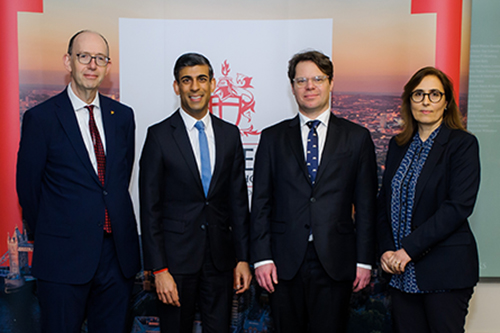
Rt. Hon. Rishi Sunak MP delivers 2022 Mais Lecture at Bayes
Chancellor of the Exchequer delivers prestigious annual lecture at Bayes Business School to set out his vision for a successful free market economy.