
By Hamish Armstrong (Senior Communications Officer), Published
Artificial intelligence (AI) has reached the ability to produce useful assets such as pictures, videos, music, adverts and even new product designs, but radical innovation can currently only be realised with the help of human guidance. This was a key discussion point for Dr Sara Jones, Reader in Creative Interactive System Design at Bayes Business School, who was invited to join a panel at this year’s Creative Central Asia festival in Uzbekistan.
Each year, the British Council brings together creative experts and practitioners from central Asia. This year, delegates from Kazakhstan, Kyrgyzstan, Tajikistan, Turkmenistan, Uzbekistan and the UK assembled in Tashkent and Samarkand.
Dr Jones was invited by the British Council to participate as part of the UK delegation, joining John Newbigin, Mayor of London’s Ambassador for the Creative Industries and Chair of Creative England, Andrew Chitty, Professor of Creative Industries and acting Chair of the CoSTAR R&D network, and Tara Solesbury, Director and Co-founder of BEYOND Studio.
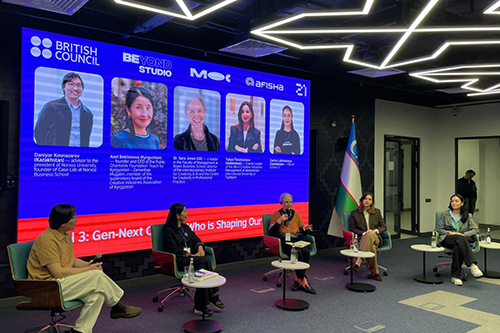
This year’s event brought together 60 delegates from all five Central Asian countries and the UK, with 185 participants attending an open forum in Tashkent and 70 people joining a live stream. The festival focused on the role of creativity in determining how well cities, regions, and countries can attract, retain, and connect people. Delegates explored key roles of education, skills, and the sense of responsibility that drives human capital, where creative industries are seen as ‘connective tissue’ between economy and identity, technology and people, and business and public meaning.
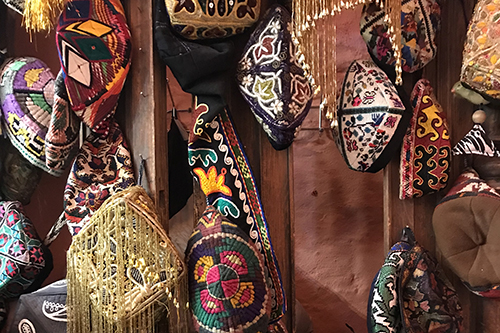
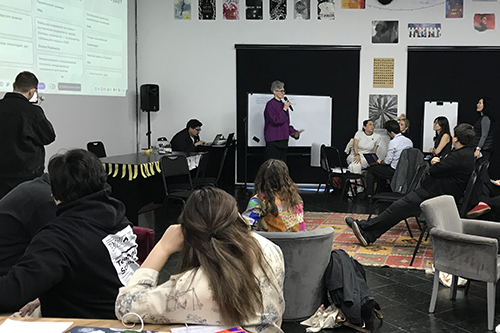
As well as celebrating the region’s rich creative and cultural traditions with visits to artists’ workshops and craftspeople making textiles, rugs and musical instruments, the festival included a day-long hackathon. The session explored the co-creation of measures through which to rank creative cities. Participating countries gave updates on their creative economies, with speed dating and open mic sessions. Expert panels discussed invisible infrastructure, the language of values and next-generation (Next-Gen) cities.
Speaking as part of the third panel, Dr Jones spoke about the role of AI in creativity, education and skills for the future.
“While AI can now be used very readily to produce a lot of things, such as pictures, videos, music and adverts,” she said, “it can only produce anything approaching radical innovation with guidance from creative human users.
“Alongside digital upskilling and development of AI literacy, we must nurture our creative selves, our creative youth, and the human skills of resilience, empathy and wisdom.
"The advent of AI implies the need to rethink many of our existing approaches to education and training at all levels, and this is a significant challenge that will itself require plenty of creative thinking.
“It was an honour to be invited to share my views. Bringing people together for productive discussions across cultural boundaries about how we work with new technologies seems more important than ever in today’s fractured climate.”
Creative Central Asia was launched in 2017 to foster dialogue between representatives of the cultural and creative industries in Central Asia and international experts. The project helps build long-term professional connections and communities, creating a shared understanding of the opportunities and potential of the region’s creative economy. Find out more and view the full schedule for this year’s event.
Other stories you might like
-
Bayes launches new Executive Master’s to develop creative leadership
New programme backed by Apprenticeship Levy to provide launchpad for aspiring leaders in the creative industries.
-
Creative Industries Finance Forum brings together creative leaders and investment experts
Bayes Business School hosts conference to address challenges in financing the creative industries.
-

Innovating for Impact: How to build thriving startup ecosystems at home and abroad
Bayes hosts annual entrepreneurship flagship for entrepreneurs, investors and students.