

Author and community leader Tskenya-Sarah Frazer shared her experiences as a Black British entrepreneur this Black Futures Month
Published
As an award-winning Black British business owner, Tskenya-Sarah Frazer learnt a lot about the struggles and triumphs of entrepreneurship.
Her experiences inspired her to write a book on the history and future of Black-owned businesses in the UK, ‘A Quick Ting on Black British Business’.
Last week, Tskenya hosted an event at Better Space, an affordable coworking space and joint venture by City St George’s and Islington Council, to discuss the findings of her book and to speak to other founders about their careers so far.
For the event, which marked Black Futures Month at Better Space, Tskenya was joined by Rebecca Dixon who is Head of Marketing & Promotions at talent agency Various Artists Management. The agency works with well-known artists including Tom Grennan, Melanie C, Yuneki, La Roux and The Libertines.
Also joining Tskenya was K Bailey Obazee, founder of creative agency and library PRIM which platforms Black and LGBTQ+ storytellers. Alongside this work, K is a curator and DJ as well as a project coordinator at Serpentine Galleries.

‘I never saw myself as an entrepreneur’: Tskenya-Sarah Frazer on overcoming barriers and building a business
Addressing business owners and community members at the Lunch and Learn event at Better Space on Wednesday 22 October, Tskenya spoke about growing up in Hackney in the 2000s and being inspired by the bustling small businesses around her.
When she started her own footwear brand specialising in stylish shoes in larger sizes, Tskenya said she thought she would be “the next big thing.” She has since been featured in Forbes and won a Pride of Britain award, but her journey has not been without its setbacks.
“I hit barrier after barrier. Not just microaggressions, but blatant acts of discrimination,” said Tskenya. “There was a lack of visible, intersectional representation and I couldn’t find business leaders who looked like me. Investors tend to favour founders who look and sound like themselves and that’s how so many of us are shut out.”
But Black entrepreneurship has existed throughout history, a point Tskenya demonstrated at the event.
“From Ignatius Sancho to Madam C.J. Walker to the Windrush Generation - we’ve always built, created, and innovated. I wrote this book to document our history, to offer a guide, and to imagine a future where Black entrepreneurs are seen, supported, and celebrated,” she told the audience.
Today, Tskenya focuses her time as an author, broadcaster and community leader. She opened the discussion out to her guest panellists, K and Rebecca, who both work in the creative industries and they discussed the different stages of their careers to date.

Diversifying talent at every level
Referred to as “London’s coolest librarian” by The Standard, PRIM founder K spoke about the decision to platform stories by Black authors.
“Then I discovered incredible authors like Maya Angelou, and for the first time, I felt like I was reading books that truly spoke to my experience. That moment made me realise how, especially growing up in Britain, so much of what we’re exposed to is filtered. Even during Black History Month, publishers release book lists of Black authors but it’s the same names featured year after year.
“Zora Neale Hurston, for instance, was almost forgotten - she died with an unmarked grave and was only rediscovered decades later. I don’t want that to be the story today, not when we have access to so much information, literature, and opportunity to celebrate the full range of Black voices.”
Fellow panellist Rebecca echoed K’s calls to amplify the voices of Black creatives and spoke about her experiences in the music industry. She said:
"I grew up as a bit of an emo kid and loved a wide variety of music, but alternative music was at the forefront. As someone of mixed heritage, even though I also loved hip hop, I sometimes felt I had to hide that part of myself in certain spaces so not to be pigeonholed. I didn’t want people to make assumptions or expect me to be an expert on that genre just because of how I look and dismiss parts of me that are so important to who I am as a person and in a professional capacity too.
About Better Space
Better Space is an affordable coworking space and incubator for social enterprise in Islington committed to supporting underrepresented founders.
Sarah Worth, Partnership and Social Impact Manager at Better Space, said:
“We wanted this ‘Lunch and Learn’ to educate our members and local community on the beginnings of Black British businesses and to demonstrate the rich legacy which has been constrained by institutional racism. We wanted to explore the challenges founders face in today's economy, but also celebrate the successes of amazing founders, business owners and creatives.”
Other stories you might like
-
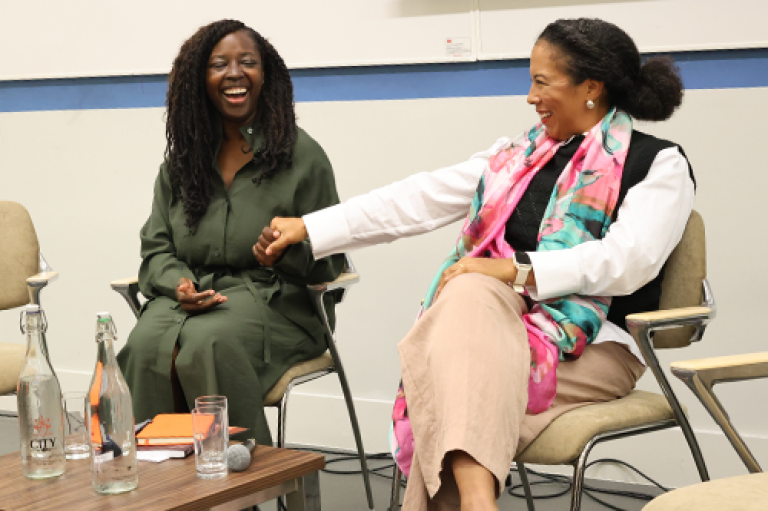
‘Black Women on the Couch’ launches at City St George’s to spotlight mental health and healing
The event featured expert panellists who shared personal, cultural and academic insights on Black women’s mental health as part of October’s Black Futures Month celebrations at the University
-
Victoria Omobuwajo: the Londoner who built her Gordon Ramsay-approved business from scratch
Victoria started her plantain snack business as a student at Bayes Business School, now her products are stocked at Selfridges
-
Queer families and the law after I do
The City Law School’s Dr Alexander Maine awarded grant to investigate how LGBT people navigate family relationships, law and society.


