

By Hamish Armstrong (Senior Communications Officer), Published
Parenthood drives a sizeable wedge in earnings, leisure and opportunities between men and women according to Barbara Petrongolo, Professor of Economics at the University of Oxford, as she addressed the Global Women’s Leadership Programme at Bayes Business School.
Drawing on extensive research of what causes and exacerbates gender gaps – present not only in remuneration but also education, unpaid work hours and leisure time – Professor Petrongolo outlined and critiqued factors most widely considered to have contributed to such disparities.
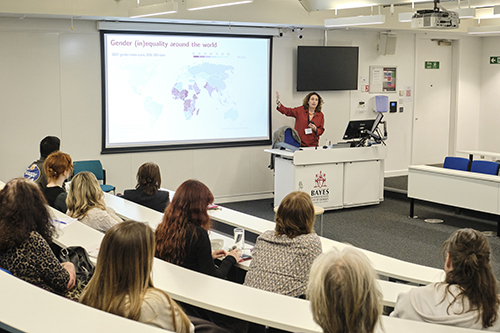
Exploring widely reported reasons, including differences in perceived levels of confidence and interests, and fertility cycles, Professor Petrongolo cited an increasing body of academic literature that contradicts stereotypes driven by economic beliefs and the media. Having children and starting families, she said, plays a major role in women’s ability and desire to work the same number of hours as men in certain roles, but evidence suggested physical and biological effects of giving birth were not a significant part of this – as proven with similar hurdles faced by foster parents.
Professor Petrongolo illustrated further statistics that potentially explained male dominance in certain sectors, including outcomes of violence in work where man-on-man incidents would tend to lead to the perpetrator leaving an organisation, but man-on-woman violence typically led to a victim vacating their role.
Following the lecture, Giacinta Cestone, Professor of Finance and Director of the GWLP at Bayes, hosted an audience Q&A. Topics of discussion explored how research findings could help improve equality beyond simple box-ticking exercises in recruitment, why gender pay gaps exist across so many professions, the impact artificial intelligence (AI) is likely to have on women in the labour market, and how stereotypes could be conquered to get more women into science, technology, engineering and mathematics (STEM) roles.
Professor Petrongolo said:
“The labour market progression of women has been the most significant social and economic change in the last 50 years, with major inroads in education, employment and leadership gaps.
“While gender gaps continue to narrow and generate more attention in the media and academic research, it is clear there is more to be done with striking contrasts existing in levels of pay, unpaid hours, leisure time and opportunities.
“Greater incentives for men to take longer paternity leave, for example, could reduce the pressures on female partners and help minimise the negative impact that looking after children appears to have on inequality.
“Similarly, greater parity in the job market should be triggered at the stage of application rather than shortlisting and interviewing. By the same token, encouraging women to take more of an active interest in STEM subjects needs to take place during formative school years to increase low returns in the labour market.”
Professor Cestone said:
“The Global Women’s Leadership Programme aims to inspire both current and prospective female leaders who want to develop and succeed in entrepreneurship, leadership and senior management.
“We offer excellent networking opportunities and scholarships for future leaders, as well as a programme of insightful events.
“Although we still have a long way to go to achieve gender equality in this country and across the world, separating perceptions from data is a big step towards finding practical solutions. Our thanks go to Professor Petrongolo for sharing her excellent and thought-provoking research with us.”
Read more about the Global Women’s Leadership Programme at Bayes Business School.
Other stories you might like
-

Philanthropy among wealthiest donors is increasing but better financial advice is needed, finds new report
New research co-authored by Bayes Business School for Barclays examines trends in UK philanthropy.
-

Lending surges in UK commercial real estate market
The UK commercial real estate market is increasingly attractive to lenders but defaults are on the rise.
-

Panel explores breaking down the barriers for women entrepreneurs
Bayes Global Women's Leadership Programme hosts trailblazing female entrepreneurs panel