
Published
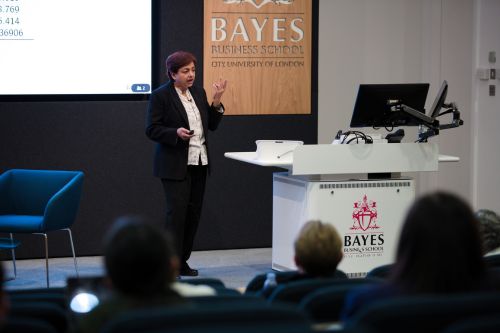
The surprisingly ‘dense’ relationships between global supply chains, financial conditions and the role of banking in international trade were explored during the annual Henry Thornton Lecture at Bayes Business School last week.
Hyun Song Shin, Economic Adviser and Head of the Monetary and Economic Department at BIS (the Bank of International Settlements), outlined the limitations of the traditional macroeconomic perspective on global trade. This, he said, sees international economics as the sum of individual ‘island’ economies and assumes trade flows and financial movements are determined by aggregates such as GDP, savings and investment.
However, Mr Shin argued that this perspective ignores the evidence that global value chains are dense, overlapping networks of firms that span countries and sectors. These interdependencies create complex relationships far more nuanced than a simple flow of goods from one country to another.
Using the automative industry as an example, he said. “International supply chains make up a very dense network. Everyone is connected to everyone else – there are a lot of crisscrossing boundaries. The global economy is not just a collection of islands. We need a network-based approach that reflects the interconnected nature of modern global production.”
Financing capital
Mr Shin illustrated how a single product moves through multiple countries, accruing value at each stage – and therefore depending on financing in the form of working capital. The length and complexity of the supply chain exponentially increases the working capital needed, as inventories at each stage grow in value.
This, he said, generates a demand for capital that financial institutions, especially banks, provide in the form of short-term credit and liquidity – giving those institutions a central role in global trade. Without this credit infrastructure, firms would face severe liquidity constraints that could impede or even end production.
mrShin argued thatfinancial conditions influence not just the financing of trade but trade itself. When financial conditions tighten – through higher interest rates, widening credit spreads or a strengthening US dollar – firms may opt to shorten supply chains. Rather than outsourcing production stages abroad, firms may shift to more expensive local alternatives to reduce financing burdens. This contraction can lead to less global trade and affect industrial production.
“Decisions around the location of production sites can be shaped by financial conditions. And as we've seen in the last couple of months, it could be that there are other constraints kicking in. There are going to be trade barriers. There's going to be uncertainty. If those kick in, then that's going to tilt the balance even more towards one direction or the other. All of this has huge implications for the real economy.”
He cited data from the Goldman Sachs Financial Conditions Index (GFI) and firm-level metrics such as accounts receivable. When financial conditions tighten, accounts receivable decline, suggesting firms are extending less trade credit and that supply chains are contracting.
An interconnectedness index, created by averaging upstream and downstream exposure, shows that firms most embedded in global supply chains are not only the most finance-intensive but also the most profitable and reliant on short-term debt. These firms also hold less cash, indicating a dependence on continuous access to credit.
However, these highly interconnected firms are vulnerable to sharp declines in output and sales when financial conditions tighten.
He said: “The firms that have higher interconnectedness get hit harder when financial conditions tighten. So, if you're really integrated into the global trading system and financial conditions tighten, you're going to get hit much harder. The message here is the vulnerability of global production lines. The impact is pretty much immediate and the maximum effect comes within around six months."
The gravitational pull of finance on trade
Listing the components of the Goldman Sachs Financial Conditions Index, he noted that three of them – the spread, stock market performance, and fluctuations in the US dollar – have a significant impact on accounts receivable and, therefore, trade.
Surprisingly, the research suggests that changes in interest rates – the primary focus of macroeconomic models – are less important.
Concluding his address, Mr Shin said that policymakers and market players focussing on trade policy or macroeconomic indicators do not get a full, rounded picture of global economic activity. Linking his lecture back to Henry Thornton and, he said that the financial architecture that underpins global production networks, including the banks that provide liquidity and credit, are indispensable to the smooth functioning of international trade.
Welcoming Mr Shin to Bayes, Professor Barbara Casu, the School’s Deputy Dean and director of its Centre for Banking Research, said: “Before joining BIS in 2014, Mr Shin was the Hughes Rogers Professor of Economics at Princeton University. He has also worked at Oxford and at the London School of Economics – so I would say that his is almost a Londoner! Mr Shin has been an intellectual leader in the fields of banking, international finance and monetary economics – topics on which he has published widely.”
She also noted that in 2010, Mr Shin returned to his native South Korea as economic adviser to the then president – and played a major role in shaping the agenda of the G20 during the country’s presidency of the global gathering.
Vasso Ioannidou, Professor of Finance at Bayes, chaired a Q&A session and thanked Mr Shin for a stimulating presentation packed with insights.
Other stories you might like
-

ECB leader’s Mais Lecture highlights added value of financial education for all
ECB leader’s Mais Lecture highlights added value of financial education for all
-
Bayes lecture explores open banking and credit access
Professor Puri explains how open banking is boosting access to credit for financially excluded