

The Centre for Justice Reform and the Legal Practice Hub co-host panel discussion examining the forthcoming review.
On Tuesday 14 October, the Centre for Justice Reform and the Legal Practice Hub at City St George’s, University of London co-hosted a well-attended panel discussion at The City Law School examining the Law Commission’s forthcoming review of homicide law.
The panel brought together experts from academia, political advocacy, and practice:
Dr Andrea Preziosi of the Law Commission, Harriet Wistrich, founder and CEO of the Centre for Women’s Justice (CWJ), and Alex Benn, barrister at Red Lion Chambers and Senior Lecturer at University College, Oxford.
Announced in December 2024, the Law Commission’s review is the first in nearly two decades. Its last review, in 2006, recommended major reforms to the classification of murder and manslaughter – the majority of which were not implemented by the then-government.
Since then, the same issues identified have persisted, while new challenges have emerged as society and the law has moved on. The forthcoming review seeks to examine how the law of homicide now operates in light of modern understandings of culpability, mental health, and domestic abuse.
Dr Preziosi outlined the review’s broad scope: to reconsider every element of homicide law, from offence definitions, to full and partial defences, and sentencing. At the core of the review is the concept of “fair labelling” – whether the two-tier division between murder and manslaughter adequately reflects differing degrees of blame.
The Commission is considering a three-tier structure (first-, second-, and third-degree murder/manslaughter) to introduce more nuance, ensuring that those who kill in profoundly different circumstances are not treated identically under law.
Preziosi also highlighted problems with the current partial defences of loss of control and diminished responsibility, both of which have faced sustained criticism in recent years. The former continues to rely on a model of sudden anger, which often does not consider the experiences of living in an abusive relationship, while the latter has become increasingly medicalised, often obscuring other significant contexts behind a killing.
Harriet Wistrich presented the Centre for Women’s Justice (CWJ) research into women who kill their abusers, arguing that current defences fail to reflect the realities of coercive control – a reality that is reflecting in the sentencing statistics. “Self-defence and loss of control are almost impossible as defences for women to use successfully,” she said.
Wistrich advocates a new partial defence based on a ‘social entrapment’ model – already used in jurisdictions like Australia and New Zealand – which recognises how sustained abuse can erode autonomy and shape a person’s actions.
Concluding the discussion, Alex Benn examined the doctrinal limits of current defences and complicity rules, including the controversial outcomes of accessory liability. Alex questioned whether the criminal law’s focus on defendant’s as abstract individuals can adequately addresses structural inequalities that can – and often do – shape criminal behaviour. Following robust audience questioning, the conversation continued over a networking session.
Byline: this article was written by Joseph Ricciardiello, The City Law School, City St George's, University of London.
Related schools, departments and centres
Other stories you might like
-
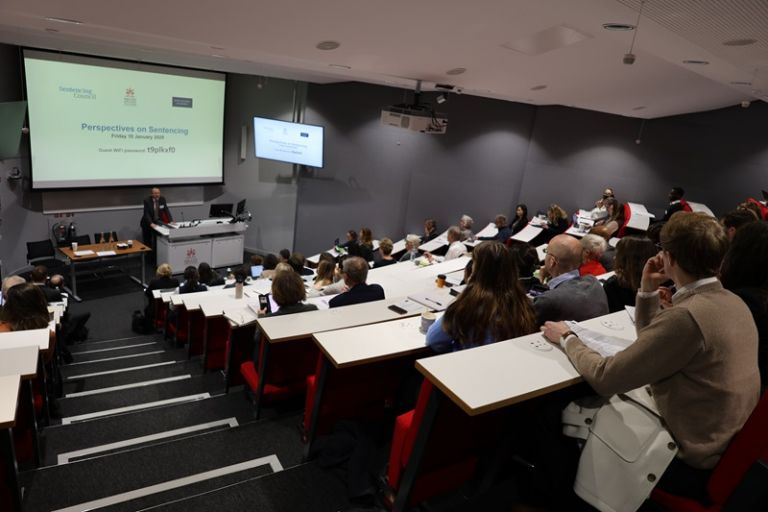
The City Law School’s Legal Practice Hub joins forces with both the Sentencing Council and Sentencing Academy on seminar
The seminar exploring perspectives on sentencing, now a biennial event, was opened by The Lady Chief Justice, the Sentencing Council’s President, and its Chairman, Lord Justice William Davis.
-

Launch of City’s Innocence Project at the Supreme Court
The City Law School launched the new pro bono service at a reception celebrating the Centre for Justice Reform’s first anniversary.
-

What will the UK Supreme Court gender ruling mean in practice? A legal expert explains
Dr Alexander Maine, Senior Lecturer at The City Law School, writes in The Conversation UK..


