
City St George's tradition of providing high quality education relevant to business and the professions dates back hundreds of years. For many of our graduates, time spent at City St George's laid the groundwork for leadership, innovation and excellence that have changed the world we live in.
Click on a time period below to discover its significance in City St George's heritage.
1700 – 1899
1733 – St George’s Hospital opens
St George’s Hospital opens in Lanesborough House at Hyde Park Corner. The new hospital spreads over three floors and accommodates 30 patients. By 1744, the hospital grows to accommodate over 250 patients.
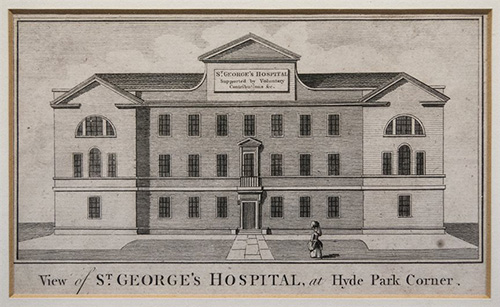
View of St Georges Hospital by William Henry Toms c.1740
1752 – Teaching begins at St George’s Hospital
A formal register of pupils studying under the physicians and surgeons is maintained from 1752. The earliest recorded course of lectures at the hospital is delivered by Sir Everard Home some time before 1803.
1756 - Notable Alumni
The eminent anatomist and surgeon John Hunter begins to undertake courses of study at St George’s Hospital. Hunter is often referred to as the Father of Modern Surgery and is the first of many prominent figures in medicine to attend City St George’s.
Former student Edward Jenner eventually develops the first vaccination against smallpox, which leads to the eventual eradication of the disease. The hide of Blossom, the cow used in Jenner’s smallpox experiment, was presented to the hospital in 1857 and has remained in City St George’s possession ever since.
1834 – Medical School is formally established
A medical school is established on Kinnerton Street by surgeon Benjamin Brodie, who would eventually be appointed as the first President of the Royal College of Surgeons and the first President of the General Medical Council.
Brodie leases the school back to St George’s Hospital for use as an anatomy theatre, a lecture room and a museum.
1835 – Official opening of St George’s Hospital Medical School
The official opening ceremony for the medical school, now named St George’s Hospital Medical School, is held in 1835 in the Anatomy Theatre. The ceremony features the dissection of an ancient Egyptian mummy.
1836 – St George’s Medical School joins the University of London
St George’s Hospital Medical School becomes a constituent college of the University of London soon after the latter’s establishment in 1836.
1852 - The Inns of Court School of Law founded
The Inns of Court School of Law was founded. One of the earliest providers of legal education in London, it would become a part of The City Law School in 2001.
1858 – Gray's Anatomy is published
Gray’s Anatomy, the product of the collaboration between Henry Gray, perpetual student at St George’s Hospital Medical School, and Henry Vandyke Carter, demonstrator in anatomy at the school, is published.
The American medical drama Grey’s Anatomy is a play on words referring to both the textbook and the name of the series’ lead character.
1868 – Medical school is moved to the main hospital site
St George’s Hospital Medical School is moved from Kinnerton Street to the main hospital site at Hyde Park Corner. The hospital and medical school have shared a site ever since.
1876 - Notable Alumni
Herbert Henry Asquith, British Prime Minister from 1908 to 1916, graduated from The Inns of Court School of Law. Asquith was the first of many global leaders, including Mohandas 'Mahatma' Gandhi, Clement Attlee, Jawaharlal Nehru, Margaret Thatcher and Tony Blair, to pass through what is now The City Law School.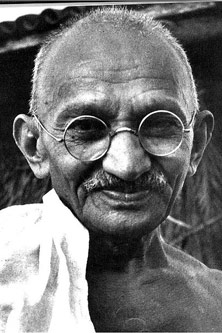

1877 - St Bartholomew's College of Nursing founded
St Bartholomew's College of Nursing was founded, affiliated with London's oldest hospital, St Bartholomew's. The College of Nursing would later be incorporated into the School of Health & Psychological Sciences at City, University of London.
1894 - Northampton Institute founded
 The Northampton Institute was founded. With the objective of promoting 'the industrial skill, general knowledge, health and wellbeing of young men and women belonging to the poorer classes', the first departments established in the Institute were Mechanical Engineering and Metal Trades, Artistic Crafts for Industry, Applied Physics and Electrical Engineering, Horology, Electro-chemistry and Domestic Economy.
1898 - College Building opens
The College Building was officially opened by the Lord Mayor of London.
1900 to 1949
1908 - Olympic Games hosted at The Northampton Institute
 The Great Hall at the Northampton Institute plays host to boxing at the first London Olympic Games. Great Britain excels in the sport, winning 14 of the 15 medals awarded. The swimming pool, now a study area for the School of Communication and Creativity, is also used.

1909 - Aeronautical Engineering courses introduced
 The Northampton Institute introduced courses in Aeronautical Engineering, the
first offered in the United Kingdom. In this year, the Institute also presented its first candidates for University of London BSc degrees.
1914 to 1918 - World War I
The Northampton Institute plays a key role in the First World War with staff and students producing munitions, military optical aids and parts for radio telegraphic stations. All departments also participate in schemes to retrain and find employment for wounded ex-servicemen.
Following the fight of the ‘St George’s four’, St George’s Hospital Medical School admits its first female students to aid with wartime staff shortages. Helen Inglby, one of the four women accepted alongside Ethelberta Claremont, Marian M. Bostock and Elizabeth O'Flynn, goes on to become Pathologist of the Albert Einstein Medical Centre in Philadelphia.
1927 - Optometry courses introduced
 The Department of Optometry and Visual Sciences is founded at the Northampton Institute, making it one of the first establishments in the world to educate optometrists, joining St George’s Hospital Medical School, which had been teaching Opthalmic surgery since the late 1800s.
1939 – 1945 – World War II
St George’s Hospital becomes a unit of the Emergency Hospital Service, providing 200 beds for war casualties and 65 beds for the civilian sick.
Meanwhile the Northampton Institute provides training courses for members of the armed forces in skills ranging from optics manufacturing to wireless mechanics. Buildings at The Northampton Institute (modern-day Clerkenwell campus) suffered bomb damage, notably the Great Hall. Post-war reconstruction work would only be completed in 1953.
Due to the outbreak of the war, it is decided that St George’s Hospital should be rebuilt and transferred out of the city centre.
1946 – Development of the Northampton Institute begins
The Northampton Institute enters a period of development and expansion that would set the stage for its transition into a university.
Between 1946 and 1956 the number of courses grows, student numbers increase, and academic research becomes more important as faculty members are given the chance to take research leave from teaching and appoint research assistants.
1947 – Notable Alumni
Dame Muriel Powell, who trained at St George’s Hospital, returns to take up the position of matron. Powell would hold this position for 22 years before going on to become Chief Nursing Officer for the Scottish Home and Health Department.
1948 – National Health Service (NHS) introduced
The NHS is established on 5 July 1948 to provide healthcare for all citizens based on need, rather than the ability to pay. This made Britain the first western country to offer free at the point of use medical care to the whole population.
The NHS is funded by the taxpayer and managed by the Department of Health, which sets overall policy on health issues.
With the introduction of the NHS, St George’s Hospital becomes part of the St George’s Hospital Teaching Group of the South West Metropolitan Regional Hospital Board. Soon after, it is decided the new hospital should be built on the former Grove Fever Hospital and Fountain Hospital site in Tooting.
1950 to 1979
1951 – Notable Alumni
Celebrated watchmaker George Daniels begins his studies at The Northampton Institute. Today, his legacy lives on through an annual inaugural lecture and the iconic Clerkenwell Campus clock named in his honour.
1954 – Advancements in cardiology
Aubrey Leatham is appointed as St George’s first consulting cardiologist. He is best known for designing a new and improved version of the stethoscope, and for developing a prototype pacemaker. In 1958, Leatham and his technician Geoffrey Davies carry out the first indwelling pacemaker operation in the UK.
1955 - Summer school lays groundwork for British Computer Society
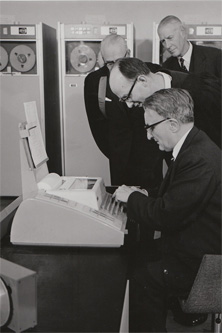 The Northampton Institute offered a summer school on the use of electronic digital computers and calculators in accountancy, costing and management, laying the groundwork for the foundation of the British Computer Society.
1957 - Northampton College of Advanced Technology
Following a government review highlighting the growing need for technical and scientific personnel in British industry, the Northampton Institute became Northampton College of Advanced Technology, with a mandate to increase student numbers and offer advanced degrees whilst retaining the former Institute's close links with industry.
1961 - Department of Social and Industrial Studies founded
The Department of Social and Industrial Studies was formed, offering classes in social sciences, industrial administration and management studies.
1966 – The City University created by Royal Charter

A government report into higher education recommends that the Northampton College of Advanced Technology become a university. It becomes The City University, created by Royal Charter. Dr James Tait is appointed as the first Vice-Chancellor and Oliver Thompson as the first Pro-Chancellor. Together, they approach the Lord Mayor of London and establish the unique arrangement that continues today, in which the Lord Mayor in office is invited to be the Rector of the university.
1969 – New buildings at The City University open
Construction of the Drysdale and Centenary Buildings is completed, and they are officially opened. The following year, the University Building opens. By 1974, the Tait Building will be completed and opened.

1971 – Apollo 15 astronauts visit The City University
The astronauts of Apollo 15 visit The City University and present Vice-Chancellor Tait with a piece of the heat shield from the Apollo 15 command module.

1973 – Building starts in Tooting
Building starts on the new St George’s Hospital site in Tooting.
1975 - First Journalism degree course launches

The City University offered a Diploma in Journalism, capitalising on its proximity to Fleet Street and its long experience of educating for the professions.
1976 – Medical School opens in Tooting
The first phase of the new St George’s Hospital Medical School opens in Tooting with 80 students.
1977 - Centre for Legal Studies founded
The Centre for Legal Studies is established at The City University, offering the Graduate Diploma in Law.
1977 – City Technology Limited founded
City Technology Limited is established to develop a new oxygen sensor, designed by academics from The City University. The sale of the company in 1993 for £24.5m marks one of the most successful commercialisations of intellectual property in British academia.
1978 - Professor Raoul Franklin CBE appointed Vice-Chancellor
Professor Raoul Franklin is appointed Vice-Chancellor of The City University. He would remain in the post for 20 years and be made a CBE in 1994 for his service to the university.
1978 – Notable Alumni
The birth of the first ‘test-tube baby’ marks the success of alumnus and fertility treatment pioneer Patrick Steptoe’s groundbreaking work in developing in vitro fertilisation (IVF).
1980 to 1999
1980 – HM The Queen opens Hospital and Medical School in Tooting
HM Queen Elizabeth II formally opens the new St George’s Hospital and Medical School in Tooting on 6 November 1980.
1988 - School of Engineering founded
The School of Engineering was formed under the guidance of Professor Ludwik Finkelstein, its first Dean.
1990 - School of Informatics founded
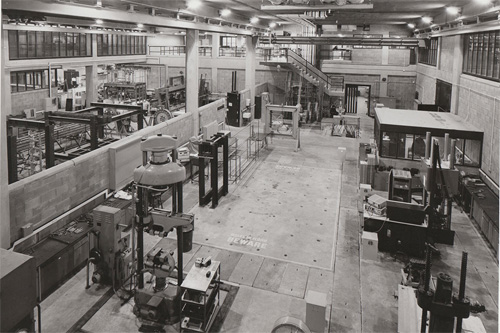
The School of Informatics was formed, bringing together the departments of Information Science, Business Computing and Computer Science.
1994 – The City University celebrates 100 years

The City University celebrates 100 years since its founding as the Northampton Institute with a series of high-profile public lectures and a gala concert in The Guildhall.

1995 - Health-related institutions join The City University
St Bartholomew’s School of Nursing and Midwifery and the Charterhouse College of Radiography are incorporated into The City University, later forming part of the School of Health and Medical Sciences. In the same year, the Charterhouse College of Radiography was also incorporated into the university.
1995 – Faculty of Health and Social Care Sciences established
The Faculty of Health and Social Care Sciences, a joint collaboration between St George’s Medical School and Kingston University, is established, offering health and social care education in nursing, midwifery and radiography.
1998 - Professor David Rhind appointed Vice-Chancellor
Professor David Rhind is appointed as Vice-Chancellor of The City University, remaining in the post until 2007.
2000 to 2019
2000 – Graduate-entry medicine programme introduced
St George’s Medical School is the first UK institution to launch the MBBS Graduate Entry Programme, a four year fast-track medical degree course open to graduates in any discipline.
2001 – The City Law School is founded
The Inns Court School of Law joins The City University and with the Centre for Legal Studies. Together they form The City Law School.
2002 – Widening Participation Unit is launched
The Widening Participation Unit is launched at St George’s Medical School, with the purpose of promoting fair access to university for people from underrepresented areas of society.
It has since won 15 awards, including The Guardian's Public Service Award for Innovation and Progress in Diversity and Equality and the Times Higher Education Award for Widening Participation Initiative of the Year.
2003 - School of Arts founded
The School of Arts is founded at The City University, bringing together the departments of Music, Journalism and Publishing, and Cultural Policy and Management. A dedicated building for the school, now named the Rhind Building in honour of Professor David Rhind, opened the following year.
2005 – Medical school becomes St George’s, University of London
On St George’s Day in 2005, the Medical School formally changes its name to St George’s, University of London.
2008 – Anniversary of first pacemaker operation
50 years after the first indwelling pacemaker operation in the UK was carried out st St George’s Hospital, the 50,000th operation is also successfully performed at the hospital.
2009 – Health Innovation South West launched
Health Innovation South West, formerly AHSN, is launched in October 2009. It is a new membership network of organisations in South West London, including St George’s, that pools members’ expertise and experience to improve patient care and innovation.
2010 - Professor Sir Paul Curran appointed Vice-Chancellor

Professor Sir Paul Curran serves as Vice-Chancellor of The City University until 2016, then serving as President until 2021 after the joining of the University of London Federatio. Sir Curran is knighted in the 2016 New Years Honours for services to higher education.
2012 - Environmental initiatives recognised
In July 2012, The City University's Environmental Management System was awarded the EcoCampus Platinum Award and ISO 14001 certification in recognition of the University's commitment to reducing its environmental impacts and to integrating sustainability into its daily services and activities.
2015 – First female Principal
St George's appoints its first female Principal, Professor Jenny Higham. A consultant gynaecologist who has held several leadership roles in academia, Professor Higham has research interests in reproductive medicine and medical education. She is also Chair of the Medical Schools Council.
2016 - The City University joins the University of London
Following a period of significant progress, City joined the University of London federation on 1st September 2016. The University of London was founded by Royal Charter in 1836. The City University changed its name to "City, University of London" to reflect this change.
2017 – Opening of City's new main reception and Pavillion
Her Royal Highness the Princess Royal, Chancellor of the University of London, opens the transformed Northampton Square main reception and Pavilion.

2019 – City, University of London's 125th anniversary
City, University of London celebrates its 125th anniversary with a series of events and activities.
2020 to present
2021 - Cass Business School is renamed Bayes Business School
Cass Business School is renamed Bayes Business School after the Reverend Thomas Bayes, creator of the Bayes Theorem.
City 2021 – Professor Sir Anthony Finkelstein CBE FREng appointed President
Anthony joined City, University of London from his position as the Government’s Chief Scientific Adviser for National Security, which he held from 2015-2021.
Previously he held the positions of Dean of the UCL Faculty of Engineering Sciences and Head of UCL Computer Science.
His scientific work is in the broad area of systems engineering.

2022 – City, University of London acquires Urdang Academy
City, University of London acquires the prestigious performing arts school, Urdang Academy, based at Finsbury Town Hall.
2023 – Bayes opens 33 Finsbury Square
Bayes opens its new building at 33 Finsbury Square. It becomes home to students on the MBA, PhD and Executive Masters’ Apprenticeship Programmes, and is also the new hub for Executive Education.

2024 – City, University of London merges with St George’s, University of London
City, University of London merges with St George’s, University of London creating a powerful multi-faculty institution. The combined university becomes one of the largest suppliers of the health workforce in the capital and one of the largest higher education destinations for London students.
Historic sources of funding
Read the university's review of its historic sources of funding which has determined if there were any links with the historic transatlantic slave trade and made appropriate and considered recommendations.
City, University of London merged with St George’s, University of London on 1 August 2024 to become City St George’s, University of London. We are currently operating under a dual-running model, so you may still see references to our legacy institutions.