

By Chris Mahony (Senior Communications Officer), Published
Statutory gender quotas on the boards of public companies increase the number of women CEOs in private firms, research from Bayes Business School (formerly Cass) suggests.
The study identified an 8-13 per cent increase in the number of women leading private firms in 11 European countries with such quotas in place. The result has added significance as an EU directive mandating such quotas comes into force in June.
Greater visibility of women in leadership roles, the academics suggest, helps break down prejudice in companies untouched by regulation. However, the impact is only visible in industries where listed companies are major players. Co-author Francisco Urzua, Professor of Finance at Bayes, said the impact was also much stronger in countries where the quotas are legally enforced, such as Italy and France, than in those relying on voluntary targets.
In the UK, which has voluntary targets, 15.3 percent of private firms appointed female CEOs. In France, Italy and Germany, all of which have mandatory board quota targets, the respective figures are 26.6 per cent, 23.6 percent and 17.1 per cent.
Professor Urzua said: “When these reforms are discussed, people assume they have little impact beyond the boardrooms of listed companies. However, our study shows that large privately-owned firms do react to moves by their listed competitors. The owners of such firms re-evaluate their own recruitment policies and possible biases when seeking a new CEO.”
Many European countries have introduced quotas or voluntary targets since Norway legislated for female representation on the boards of public companies in 2003. Most opted for at least 33 per cent but France raised that to 40 per cent in 2015. From June, the EU’s Women on Boards Directive requires listed companies to have at least 40 per cent representation of the “underrepresented gender” in non-executive roles, or 33 per cent for all board members combined.
Rigorous enforcement matters
Professor Urzua said: “The spillover impact is greatest in countries that have adopted mandatory quotas with deadlines, and which are backed by clear enforcement mechanisms with little scope for evasion and tough penalties. In countries with weaker monitoring or less credible penalties, there are no spillover effects.
“It’s likely that the broader public debate and visibility of female leaders that are generated when listed firms must comply with binding requirements encourages private firms to update their beliefs and practices around female leadership.”
Other factors also shape the spillover effect of an individual board appointment at a listed company, co-author Professor Sonia Falconieri said.
“Some female board appointments have a bigger impact on private firms than others. We found a particularly significant impact if the woman is an experienced director and she has been appointed to a company that is a significant force in their sector.
It appears private companies also sit up and take notice if the appointment breaks a male monopoly on boardrooms in their own industry. The impact of these appointments on subsequent recruitment of women to CEO roles was twice that of firms in other sectors.
She continued: “The introduction of quotas in boardrooms has clearly provided a much-needed boost to women leaders and specialists beyond the listed company sector. Both listed and private companies in the EU should embrace the EU’s Women on Boards Directive as an opportunity to re-balance their leadership team to ensure they are tapping into the widest possible talent pool.”
The academics studied 20 years’ worth of CEO appointment data covering the UK, Italy, Austria, Belgium, Germany, Denmark, Spain, Finland, France, the Netherlands and Sweden.
While quotas have changed boardrooms, progress towards gender balance in the top leadership roles of listed companies has been much slower. Women make up just 8 per cent of the CEO cadre and 15 per cent of executive committees.
Other stories you might like
-
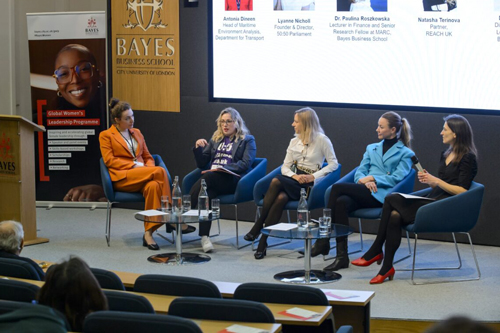
Panel explores how women can climb ladder in 'male' industries
Women leaders discuss the challenges for women in male-dominated industries
-

Women in boardrooms: after ten years of equality drives, it’s time for quotas
Professor Keith Cuthbertson writes for The Conversation about the need for boardroom gender quotas
-

Panel explores breaking down the barriers for women entrepreneurs
Bayes Global Women's Leadership Programme hosts trailblazing female entrepreneurs panel