
By Hamish Armstrong (Senior Communications Officer), Published
Removing organisational ‘sludge’ to focus on the most meaningful and strategic workplace tasks was the topic of discussion as André Spicer, Executive Dean and Professor of Organisational Behaviour at Bayes Business School, and Mats Alvesson, Professor of Organization Studies at the University of Bath, launched their new book The Art of Less (Bloomsbury 2025).
Workplace sludge refers to bureaucratic obstacles that hold an organisation back from focusing on important tasks. Common examples include excessive meetings, following procedures, documentation, training and other forms of administration that can prevent managers and others from carrying out work that adds value to their role. The text is aimed at leaders and employees as a guide for breaking down barriers towards achieving more by doing less.
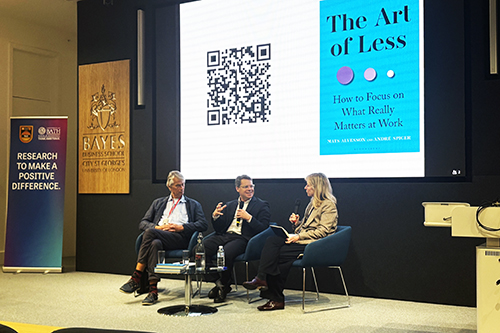
“Administration creates all kinds of problems and disruption”
Professor Spicer opened proceedings by introducing the concept of sludge, and importance of finding balance between organisational ‘chaos’ that is void of any process or direction, and the ‘sludge pit’ where offices become overburdened by red tape.
Professor Alvesson, also of Lund University and a Visiting Professor at Bayes, then presented six common ‘P’s of sludge – policies, paperwork, platforms, practices, projects and positions – and the factors that give rise to it, including legislation, a culture of fear and rising levels of expectation and narcissism.
“When addressing problems and implementing change, it is natural for leaders to think about what needs to be added, rather than replaced or minimised,” he said.
“These new tasks, processes and ways of doing things adds to workload and also need to be trained, integrated and monitored – which can very easily create sludge.”
Professor Spicer outlined common evasion tactics that did not typically solve long-term issues and proposed a pipeline for identifying and reducing sludge from an organisation.
“When trying to reduce organisational bureaucracy, people commonly try quick fixes,” explained Professor Spicer.
“Turning a blind eye to an issue and avoiding doing unproductive things are both popular methods of dealing with sludge, as are window-dressing and selective compliance. These approaches rarely get around the problem successfully in the long-term.
“Our plea to leaders is to take inspiration from a model of the waste management industry. Their task should be unblock work. They need to focus on fixing the plumbing before implementing grand visions. They should also separate tasks that are of genuine importance from those where ‘good enough’ solutions will suffice.”
“One person’s sludge is another person’s strategic project”
Following the presentation, Emma Jacobs, Work & Careers Columnist at the Financial Times hosted a Q&A, diving into topics such as Elon Musk’s recent role with cutting costs in the US administration, whether artificial intelligence and post-pandemic hybrid working were helping or hindering sludge removal, and the authors’ own experiences of removing sludge as leaders in their respective organisations.
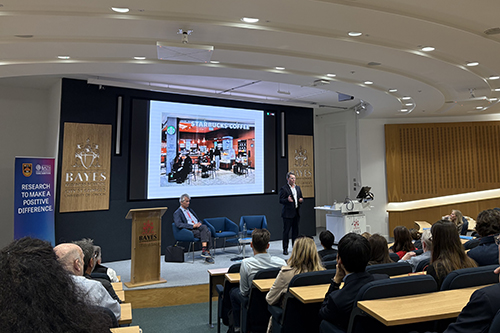
Questions from the audience focused on whether a small amount of organisational sludge could in fact be beneficial, and the skills managers should seek from job candidates in effectively challenging and removing inefficiencies.
Providing his final takeaway from the evening and the text, Professor Alvesson encouraged leaders to consider the impact of sludge.
“Sometimes it can be beneficial to slow people down if tasks require more forensic evaluation,” he continued.
“But managers must ultimately ask themselves ‘are we doing this for the good of the business and meaningful work?’, and if not, find solutions that do not add to already-inefficient workloads.”
Professor Spicer said the text was aimed at helping managers solve workplace viscosity but may also serve as a helpful personal tool.
“From trying to cancel that subscription to calculating expenses from a pile of old receipts, we all encounter sludge in our everyday lives. The Art of Less is an eye-opener and a manual for achieving more by minimising the low-value activity – helping individuals and organisations identify and move beyond sludge”.
“It is also important to recognise that sludge is not the same across organisations. While one organisation might see a particular process as hampering resources, the same process might be a valuable strategic lever in another.”
Purchase a copy of The Art of Less: How to Focus on What Really Matters at Work.
Other stories you might like
-

Bullsh*tting: The pros and cons of using empty and misleading communication
Report explores why the practice exists inside organisations, its benefits and drawbacks, and how it can be addressed
-

Insidious and potentially lethal - the strange rise of organisational parasites
'Organisational parasites' can destabilise and destroy businesses. Focus on audit and ESG claims
-

Bayes enjoys strong academic representation in World’s Top 2% Scientists index
Bayes Business School experts recognised in prestigious list of the world’s leading researchers.