

Published
Research by Bayes Business School is charting a route towards a more sustainable shipping industry.
Dr Ioannis Moutzouris, Onassis Associate Professor of Shipping Finance and Sustainability at the School’s Costas Grammenos Centre for Shipping, Trade and Finance, presented a white paper around work he and colleagues are undertaking at the Bayes Annual Research Day last month. The project is an example of one of the four core research themes at Bayes: tackling societal challenges.
The challenge around sustainable shipping draws together academics, research students and practitioners with expertise spanning shipping economics and finance, energy/commodity economics and finance, actuarial and data science, insurance, management, banking – and food policy. The food experts are from City St George’s School of Health and Medical Sciences, and their involvement is an example of the multidisciplinary research fostered by the recent merger of City and St George’s.
Dr Moutzouris’s white paper highlights the scale of the technological, financial and regulatory barriers the sector must navigate to achieve net zero emissions by 2050. The shipping industry currently produces around 2-3 per cent of greenhouse gas emissions (GHG).
A national effort
The work highlighted in the white paper is part-funded by the UK National Clean Maritime Research Hub – a consortium of 14 British universities funded by the Government and the Engineering and Physical Sciences Research Council (EPSRC), with matching funding from the universities and partners. Dr Moutzouris is a co-Investigator, leading the hub’s “Advances in maritime operations, exploitation of digitalisation and green finance” theme.
The maritime industry faces mounting international and regional pressure to cut emissions. The International Maritime Organization (IMO) initially sought to reduce emissions from ships by 40 per cent by 2030. However, two years ago it set a more ambitious goal of “reaching net zero by or around 2050”. The EU has gone further with the implementation of the FuelEU Maritime Regulation and the continued phase-in of the Emissions Trading System (ETS). The UK ETS will include domestic maritime emissions from 1 July 2026.
In April the IMO’s Marine Environment Protection Committee approved the organisation’s Net-zero Framework, which is “the first in the world to combine mandatory emissions limits and GHG pricing across an entire industry sector”. If formally adopted in October, these measures will come into force in 2027.
Squalls hit fuels transition
While shipping is relatively sustainable compared with other forms of transport, its sheer scale makes change difficult. The white paper notes that the industry must shift from fossil fuels to cleaner technologies and fuels – such as green methanol, green hydrogen and green ammonia. Yet these fuels remain costly, scarce and uncertain in terms of long-term viability.
In the short term, owners and operators can reduce their carbon footprint through:
- Operational changes, notably slower sailing speeds
- Vessel design improvements and energy-saving technologies
- Use of transitional fuels like liquid natural gas (LNG), which is less polluting than oil but still fossil-based
- Partial reliance on renewable propulsion, such as wind-assist systems.
Deeper GHG emissions reduction, however, demands expensive new vessels capable of running on zero or near zero-carbon fuels, Dr Moutzouris says – but that brings financial challenges.
The paper highlights a “trilemma” for shipowners: invest in cheaper polluting vessels, pay more for greener ships or delay investment altogether. Freight rate volatility has always influenced shipping investment, but now technological uncertainty makes decision-making even harder. Since 2018, the historical correlation between the price shipping companies can charge for transporting freight and new ship orders has fallen sharply, reflecting investor anxiety.
A dual-fuel container ship that can burn LNG costs 12-28 per cent more than its conventional equivalent, while the gap for methanol dual-fuel vessels is between 9-20 per cent. Investors, however, are not yet seeing a proportionately higher return on these higher upfront costs.
Green finance has not yet solved this gap, the paper warns, and financial incentives remain weak. The difference in loan costs between standard and green loans is just 0.23 per cent – a margin Dr Moutzouris says is simply too small to offset major additional capital expenditure.
Meanwhile, the white paper has revealed another pressing issue that has loomed into view: the ageing global fleet. Some 36 per cent of ships are over 15 years old, with only moderate levels of orders for new vessels. If demand for new ships remains becalmed, both environmental risks and disruption to global trade capacity could rise.
The white paper concludes that without stronger economic and regulatory incentives, shipping companies are unlikely to commit fully to decarbonisation.
As the authors put it: “For profit-maximising shipping companies to invest in greener vessels and technologies, there needs to be clear economic and financial incentives.”
Dr Moutzouris addressed these issues in a panel discussion about decarbonising the industry during the recent London International Shipping Week.
Uncertainty over emerging fuels and related technologies and a string of geopolitical shocks means the sector will struggle to meet targets, he warned.
“While there has been progress compared to a few years ago, at the current pace of green technology adoption, it does not seem feasible to reach the revised IMO targets and to align with the Paris climate commitments. Fuel producers and those who own and operate ships need more certainty around cash flow and green incentives if they are to step up investment.”
The UK National Clean Maritime Research Hub is intended to accelerate the decarbonisation and elimination of air pollution from maritime activity in ports and at sea. As well as environmental impacts, the hub focuses on the potential economic and social benefits of transitioning to a clean maritime future.
Global ripples
Ioannis Kyriakou, Professor of Actuarial Finance at Bayes, received £50,000 funding from the hub for the project “Decarbonizing Shipping and Its Ripple Effects on Global Trade, Shipping Taxation and Consumer Prices”.
London International Shipping Week also saw the UK Government announce a 12-month extension, and an additional £1.85 million in funding, of the current research grant for the hub.
The hub also secured a further £2 million funding for a Liquid Hydrogen Research and Innovation Facility.
Dr Moutzouris, Professor Kyriakou, Professor Christina Vogel and Dr Christian Reynolds have secured £25,000 Interdisciplinary Research Funding from City St George’s to assess the ‘Impact of Decarbonisation Greenhouse Gas Emissions Measures on Food Security and Trade in the UK’. They will seek additional external funding for this project next year.
Other stories you might like
-

Bayes professor boards shipping power list
The founder of Bayes Business School’s world-leading shipping, trade and finance centre is among Lloyd’s List’s Top 100 people in the sector.
-

Shipping Centre marks 40th anniversary at fifth Triennial Conference
The Costas Grammenos Centre for Shipping, Trade and Finance marked its 40 anniversary by hosting the 5th Athens Triennial Meeting
-
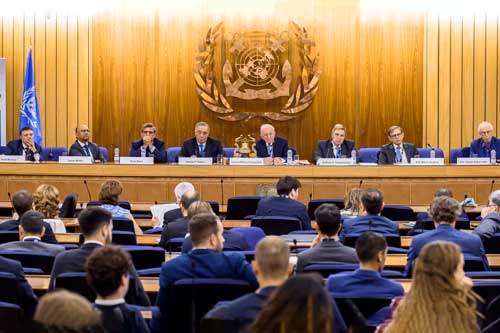
The Costas Grammenos Centre for Shipping, Trade and Finance holds 10th City of London Biennial
The Costas Grammenos Centre for Shipping, Trade and Finance holds 10th City of London Biennial