

By Chris Mahony (Senior Communications Officer), Published
Research on topics ranging from regulation and ESG to bidding strategies was unveiled at the eighth annual Mergers & Acquisitions Research Centre Conference this week.
Hosted and organised by the Mergers and Acquisitions Research Centre at Bayes Business School in cooperation with the European Corporate Governance Institute, the conference brought together more than 90 academics and M&A practitioners.
KPMG Chief Economist and UK Vice Chair Yael Selfin delivered the keynote speech addressing the country’s longstanding growth and productivity challenges (read more about her talk below).
Bayes Deputy Dean Professor Barbara Casu welcomed Ms Selfin to the School and highlighted Bayes’ high ranking amongst UK business schools and its strong performance in the official Research Excellence Framework.
“Our ranking reflects the quality of our research outputs and our research environment in business and management, including finance,” she said.
Noting the presence of many leading academics at the event, Professor Casu said the School “seeks to undertake research on the boundaries between academic and industry, exploiting our location here in the City of London”.
A unique event M&A event
Co-organiser Scott Moeller, Professor in the Practice of Finance and Director of the M&A Research Centre, said: “We understand that this is the only annual academic conference exclusively focussed on M&A and its related topics. That parallels the position of the research centre as the largest of its kind in any business school globally.”
Professor René M. Stulz from Fisher College of Business at Ohio State University kicked proceedings off with a paper asking: “Is there information in corporation acquisition plans?” He highlighted the importance of disclosure and flexibility in acquisition planning – as well as the role of such plans in informing investors.
Other papers included:
- How does financial reporting affect the market for corporate control?
- How do multiple regulators regulate? Evidence from Fairness Opinion providers
- How growth-promoting bonuses influence corporate M&A activity.
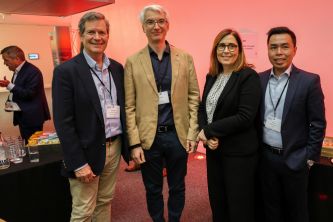
Former Bayes Dean, Professor Paolo Volpin (above with Scott Moeller, Barbara Casu and Anh Tran), returned to present a paper.
KPMG UK Chief Economist Ms Selfin called for more academic research around growth and productivity.
In the 16 years since the 2008 financial crisis, UK per capita growth has risen by just 4 per cent – compared to a 24 per cent rise in the previous decade, Ms Selfin noted. The country has a similar record on output per hour, she said.
While many other countries have recorded sluggish growth since the financial crisis, the UK is a particular outlier in terms of productivity performance, Ms Selfin said.
KPMG’s own research and analysis suggests that scale could be an issue in productivity, with larger companies growing faster than their rivals.
“We looked at a cross section of midsize firms and tracked their growth over five years. Unsurprisingly, there is a wide disparity in performance: while the turnover of the median firms increased by 13.5 per cent between 2017 and 2020, it more than doubled for those in the 90th percentile. The top performers increased their turnover more than five-fold.
“There is also a sectoral skew. IT and financial services for example, are more than twice as likely to feature in the top performing 1% of firms.”
She acknowledged this may reflect the competitive advantage of tech innovations and the increasingly dominant role of the sector.
Replicating the environment enjoyed by firms based in the UK’s capital is also crucial, she said.
“The specific reasons for success and failure across different regions are still not well understood. Policies like levelling up could benefit from a stronger evidence base, and we have had a range of policy changes over the last five years, which makes it harder to plan.”
A period of stability in the policy framework more broadly, she said, could benefit business.
Ms Selfin continued: “There is a sense that while those on the frontiers are making progress, the lack of diffusion of best practice is hampering overall growth. Our own experience speaking to businesses across the country shows that many are lacking the know-how to scale their success and embark on a period of sustained and sustainable growth.”
KPMG has been looking at whether private equity, venture capital and other private investors can accelerate the growth of medium-sized and small firms in particular, through the facilitation of shared support services and access to industry specialists.
The great WFH debate
More than four years after the first pandemic lockdowns in the UK and similar economies, companies and policymakers are also still grappling with the right approach to hybrid working, she said.
“Hybrid working has become ubiquitous, yet the right approach is still unclear. The trade-offs are becoming more apparent. While working from home can offer greater flexibility, this comes at a cost to mentoring opportunities, less contact with colleagues and difficulties in coordinating some activities. Some forms of digital communication have so far proven to be an imperfect substitution at best.”
Remote and hybrid working also raise questions about the future of cities and transport infrastructure, she said – with the commercial real estate sector going through a “slow but painful adjustment as leases are re-negotiated or reach their end”.
Concluding her presentation, Ms Selfin emphasised the opportunity for research to shape evidence-based policy and corporate planning as the UK economy seeks to recover from successive shocks.
Professor Anh Tran co-organiser from the Mergers and Acquisitions Research Centre thanked participants and said: "The quality of each and every presentation and discussion, as well as all the interactions and knowledge exchanges among participants, have been phenomenal throughout the day."
Other stories you might like
-

Gender-diverse boardrooms reduce leaked deal information, new research suggests
Mergers & Acquisitions Research Centre (MARC) study with SS&C Intralinks adds to growing support for female representation in senior leadership positions.
-

Annual Bayes global index shows enduring resilience in UK’s Mergers & Acquisitions market
Bayes MARC index on attractiveness to investors of M&A markets globally